

Hiring in the Philippines gives you access to a skilled, English-speaking workforce at competitive rates.
However, before you bring someone on board, you need to choose the right hiring model.
Your decision affects how much control you have, the ease or difficulty of compliance, and a good chunk of your daily operations, especially if you outsource a significant portion.
Below is a clear guide comparing the three most common global team outsourcing options to choose from:
IN THIS BLOG
- ➤
Understanding the 3 Most Common Hiring Models in the Philippines - ➤
What Is Remote Staffing? - ➤
Direct Hire - ➤
Through an Agency - ➤
What Is a Business Process Outsourcing (BPO) Company? - ➤
What Is an Employer-of-Record (EOR)? - ➤
Key Differences Between remote staffing, BPO, and EOR - ➤
Cost Comparison - ➤
Legal and Compliance Responsibility - ➤
Talent Control and Cultural Fit - ➤
Setup Time and Scalability - ➤
Which Model Is Best for Australian SMEs? - ➤
Outsourcing Without a Local Entity - ➤
When You Need Flexibility + Compliance - ➤
Full-Time vs Project-Based Hiring - ➤
Common Myths About BPOs and EORs - ➤
“BPOs Are Always Cheaper” - ➤
“Remote Teams Are Less Reliable” - ➤
“EOR Gives You Full Control” - ➤
Remote Staff’s Hybrid Solution: The Best of All Worlds - ➤
How Contractor-on-Record Works - ➤
When to Switch from CoR to EOR - ➤
Full Transparency + Local Support - ➤
How to Choose the Right Hiring Model for Your Business - ➤
Business Size and Growth Stage - ➤
Type of Roles (Tech, Admin, Back Office) - ➤
Timeline and Legal Risk Appetite - ➤
Frequently Asked Questions (FAQ) - ➤
What’s the main difference between BPO and EOR? - ➤
Is Remote Staff considered an EOR or a BPO? - ➤
Do I need a Philippine entity to use any of these models? - ➤
How fast can I hire through Remote Staff’s hybrid model? - ➤
What’s more compliant: hiring a freelancer or using an EOR? - ➤
Need Help Choosing Between Remote Staffing, BPO, or EOR?
Understanding the 3 Most Common Hiring Models in the Philippines
Before choosing how to hire in the Philippines, it helps to understand how each model works.
These three offshoring strategies differ in how much control the client has over the worker, the extent of legal responsibility, and how much control you keep over day-to-day operations on that side of the world:

What Is Remote Staffing?
Remote staffing lets you work with Filipino professionals in two ways: direct hire or through an agency like Remote Staff.
Direct Hire
You can hire talent directly as employees in the Philippines. This gives you full control over their tasks, schedule, and workflow.
You are also responsible for payroll, benefits, and legal compliance, which requires understanding local labor laws and registration processes.
However, handling legal compliance and taxes for a direct hire can be difficult without a legal entity in the Philippines.
Through an Agency
When hiring independent contractors through an agency (like Remote Staff), the provider recruits, screens, and matches candidates to your requirements.
The contractor works directly with you on day-to-day tasks, while the agency supports onboarding, provides monitoring tools, and assists with administrative tasks.
You manage performance and workflow, as you would with an internal team member, but without incurring the need for internal HR administration.
What Is a Business Process Outsourcing (BPO) Company?
Business process outsourcing (BPO) delivers a service using its own employees.
You pay the BPO for the output based on agreed metrics or service levels, and they decide how the work is done internally.
You don’t manage or control their staff. You don’t set their schedules, processes, or pay. The BPO oversees everything — hiring, training, supervision, and workflow — while you receive the final results.
BPOs work best when you want a hands-off setup for standardized, high-volume tasks and prefer to focus on outcomes rather than managing individual workers.
What Is an Employer-of-Record (EOR)?
An Employer of record services (EOR) legally employs your Filipino worker on your behalf.
You source and select the talent, and manage their tasks and day-to-day work, while the Employer-of-record handles all legal and administrative responsibilities.
This includes:
- Payroll and contracts
- Taxes and statutory contributions
- Compliance with DOLE and BIR regulations
- Mandatory benefits and local labor documentation
For example, Remote Staff offers two distinct services: supplying independent contractors or using an EOR for the talents you directly recruited.
Using an EOR lets you directly recruit your team and control their workflow without setting up a Philippine company or worrying about legal compliance.
It’s ideal if you want direct sourcing and management of talent while avoiding HR, administrative, and legal burdens.

Key Differences Between remote staffing, BPO, and EOR
When deciding remote staffing solutions vs EOR vs BPO, comparison across key factors can help you choose the best model for your business:
Cost Comparison
- Remote Staffing: You can hire talent directly as employees or as independent contractors through an agency.
Costs are generally lower than hiring full-time local employees directly, though pricing varies depending on skills and whether you manage HR/admin yourself or use the agency’s support.
- BPO: You pay a flat service fee for output or metrics. Pricing can be higher for fully managed services since the BPO handles staff, training, and operations.
- EOR: You cover salaries and benefits like a local employee, plus the EOR fee. Costs are slightly lower than remote staffing and it avoids the cost of setting up a local entity and ensures compliance.
Legal and Compliance Responsibility
- Remote Staffing: If hiring directly, you are responsible for legal compliance, payroll, and benefits.
If hiring through an agency, reputable providers like Remote Staff can help manage compliance, onboarding, and labor requirements.
- BPO: The BPO handles employment compliance for their own staff. You’re only responsible for overseeing the results of the BPO contract.
- EOR: The EOR assumes all legal employment responsibilities, including taxes, statutory benefits, and labor compliance. You focus solely on managing the work itself.
Talent Control and Cultural Fit
- Remote Staffing: High control — whether you hire directly or through an agency, you manage tasks, workflow, and communication, and can integrate them into your company culture.
- BPO: Low control — you receive output but don’t direct how the staff arrive at them. Testing for cultural fit is limited.
- EOR: Medium to high control — you manage daily tasks and team culture, but the EOR handles HR and compliance in the background.
Setup Time and Scalability
- Remote Staffing: Fast to set up, whether hiring direct employees or contractors through an agency.
Scaling is easy, as you can add more team members as needed.
- BPO: Moderate setup; scaling depends on the BPO’s capacity and processes. Adjusting team size or workflow can be slower.
- EOR: Quick setup without a local entity; scaling is straightforward since you can still choose who you hire while the EOR manages legal employment.
Which Model Is Best for Australian SMEs?
Australian SMEs face unique challenges when hiring overseas: maintaining control, moving quickly, and supporting hybrid or remote teams. Choosing the right model depends on your priorities for compliance, management, and flexibility.
Outsourcing Without a Local Entity
If you want entity-free hiring and access to Filipino talent without registering a local company, Remote Staffing, BPO, and EOR can all be viable options:
- Remote Staffing: You can hire talent directly as employees or through an agency as independent contractors.
Hiring directly without a local entity gives you full control over tasks and workflow, but it can be risky. You are responsible for payroll, benefits, compliance with Philippine labor laws, and avoiding misclassification of workers.
Hiring through a reputable agency reduces these risks. The agency handles sourcing, onboarding, and basic administrative support, while you retain control over day-to-day work.
- BPO: Pay for services based on output or metrics. The BPO manages its own staff and operations, so you don’t deal with HR or employment compliance.
- EOR: You source and manage the worker, while the EOR handles payroll, contracts, statutory compliance, and benefits — letting you oversee their work without legal risk.
All three options allow quick access to talent, though direct hiring without a local entity carries legal and compliance risks.
Using a reputable agency or an EOR helps you mitigate these risks while still gaining fast access to skilled workers.
When You Need Flexibility + Compliance
Australian SMEs that need control over daily work while staying compliant can choose:
- Remote Staff contractors: Flexible for project-based or ongoing tasks without full employment obligations.
- EOR services: Full-time talent can be integrated into your team, while the EOR ensures compliance with local labor laws.
This approach is ideal for hybrid or distributed teams that require both oversight and legal security.
Full-Time vs Project-Based Hiring
- Remote Staffing and EOR: Whether hiring independent contractors (short-term or long-term) directly or through an agency, or engaging talent via an EOR, you retain control over workflow and can fully integrate them into your team.
Using a reputable agency or EOR adds safeguards because both manage legal, payroll, and HR responsibilities, ensuring compliance and reducing risk.
The main difference is an agency recruits for you, while you recruit your own in an EOR.
- BPO: Suited for ongoing, standardized processes where results or output matter more than managing individual workers.
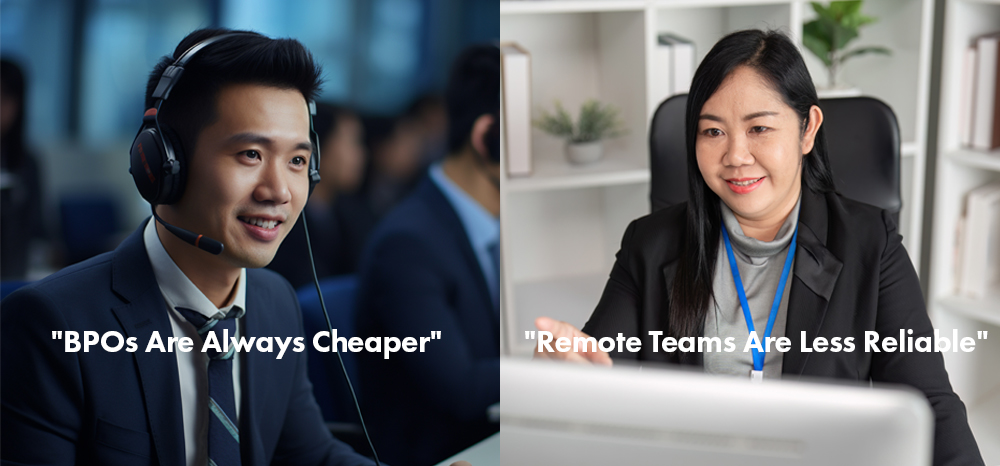
Common Myths About BPOs and EORs
Misconceptions about BPOs, EORs, and remote staffing can lead to costly errors in decision-making. Here are the most common myths — and the truth behind them.
“BPOs Are Always Cheaper”
Many assume BPOs cost less because they bundle services, but fully managed operations often come with higher fees.
In some cases, other talent acquisition outsourcing like remote staffing and employer-of-record arrangements are more cost-effective, depending on the role/s and level of control you need.
“Remote Teams Are Less Reliable”
With proper vetting, monitoring tools, and structured workflows, remote professionals can match or even exceed the performance of in-office teams.
Reliability depends on the remote workforce management systems and support you put in place, not the work setup.
“EOR Gives You Full Control”
An EOR lets you manage day-to-day work while taking care of the legal and administrative responsibilities behind the scenes.
You control tasks, workflow, and team culture, while the EOR remains the official employer on paper in the Philippines, handling payroll, statutory benefits, taxes, contracts, and compliance in remote hiring laws.
However, there are limitations within the employment framework itself.
For example, you cannot skip statutory benefits, abruptly adjust employment contracts, or change payroll schedules to suit your preferences.
It’s best to consult with the employer-of-record to ensure that adjustments comply with local laws while keeping your team protected and operations running smoothly.
Remote Staff’s Hybrid Solution: The Best of All Worlds
Remote Staff offers a flexible approach that combines compliance, control, and long-term relationship continuity.
In addition to our standard remote staffing option, we provide a separate Contractor-on-Record (CoR) model and an EOR solution as well.
If you already have remote staff, you can choose to start with a CoR setup or an EOR model, or transition from CoR to EOR later — giving you full oversight of work while minimizing legal and administrative risks.

How Contractor-on-Record Works
The Contractor-on-Record (CoR) model is a hybrid setup where Remote Staff acts as the administrative employer for your contractor, while you retain full control over their day-to-day tasks and workflow.
It is similar to an EOR, as Remote Staff handles contracts and payroll. The key difference is that under a CoR, your talents retain their independent contractor status.
This means they are not reclassified as employees, so you are not required to pay statutory benefits.
However, if you prefer, you can still provide statutory benefits voluntarily.
When to Switch from CoR to EOR
As your team grows, takes on more critical responsibilities, or becomes more integrated with your core operations, transitioning to an EOR setup can be a smart move.
While the CoR model offers flexibility and administrative support, it has limitations for teams that are central to your business.
Relying on contractors for key operations might be viewed by regulators in your country as misclassification, increasing legal and compliance risks.
Switching to an EOR ensures your team has full employment rights, while you continue to retain control over their work.
This provides a safer, legally compliant structure that supports long-term growth, stronger integration, and team stability.
Full Transparency + Local Support
Remote Staff ensures visibility into performance, hours, and workflow while providing local support for compliance and administrative matters.
This combination allows businesses to manage their teams effectively, maintain culture, and reduce risk — all without setting up a local entity.
How to Choose the Right Hiring Model for Your Business
Choosing between a remote staffing, CoR, or EOR setup depends on the pace of your team’s growth, the roles you need to fill, and your comfort level with legal and compliance responsibilities.
Unlike most agencies, Remote Staff can provide the talent you need for any team size — whether it’s a small group of contractors, a larger team, project-based, part-time, or full-time positions.
So if you’re keen to avail a CoR and EOR service but need additional staff, Remote Staff can also find suitable talents for you.
That said, here’s a look at the options if you want more control over recruitment or you already have remote talents in your team you want to transition to an EoR for compliance:
Business Size and Growth Stage
- Startups or small teams (1–3 hires): CoR through an agency is often enough if you need speed, flexibility, and low commitment.
- Growing teams (4–10 hires): EOR is ideal when you need structure, payroll support, and smoother operations.
- Scaling companies (10+ hires or long-term teams): EOR ensures statutory compliance, employee stability, and lower long-term risk.
Type of Roles (Tech, Admin, Back Office)
- Project-based or flexible roles: CoR through an agency works well for freelance-style work such as design, development sprints, or short-term admin.
- Operational or ongoing roles: EOR fits back-office, admin, customer support, and roles that require consistent workflows.
- Critical or core-business roles: EOR is the safest option for engineers, long-term tech talent, or staff managing sensitive processes where regulators may view contractor arrangements as misclassification.
Timeline and Legal Risk Appetite
- Need to hire within days? CoR or Remote Staffing through an agency gives you the fastest onboarding.
- Moderate urgency + moderate compliance needs? EOR provides payroll, government remittances, and a smoother structure.
- Long-term hires with exposure to your internal systems? EOR reduces risks, especially if regulators in your home country might view contractors as de facto employees.
Here are some questions you can answer to better decide:
Frequently Asked Questions (FAQ)
Below are quick answers to the most common questions when choosing between BPO, CoR, and EOR models.
What’s the main difference between BPO and EOR?
A BPO provides managed services where the provider controls the team, processes, and output.
An EOR lets you manage the work directly while the provider handles local employment, payroll, taxes, government remittances, and statutory benefits.
Is Remote Staff considered an EOR or a BPO?
Remote Staff is neither a traditional BPO nor a pure EOR.
We operate a hybrid model that offers:
- COR for flexible arrangements
- EOR for complete statutory compliance
This gives you more control than a BPO and more flexibility than a standard EOR.
Do I need a Philippine entity to use any of these models?
No. You can hire in the Philippines through Remote Staff without setting up a local corporation.
A CoR and EoR allow you to operate legally without forming a Philippine entity.
How fast can I hire through Remote Staff’s hybrid model?
You can typically hire within days, depending on the role.
CoR is the fastest, while the EoR may take slightly longer because they include additional steps for compliance, but onboarding is still quick compared to forming your own entity.
What’s more compliant: hiring a freelancer or using an EOR?
An EOR is significantly more compliant, especially for long-term or integrated roles.
Freelancer arrangements can raise misclassification risks—both in the Philippines and in your home country—if the contractor functions like an employee.
An EOR structure protects you by ensuring statutory benefits, taxes, and labor regulations are properly managed.

Need Help Choosing Between Remote Staffing, BPO, or EOR?
Hiring in the Philippines gives you access to skilled, English-speaking talent at competitive rates.
However, before you bring someone on board, you need to choose the hiring model that fits your goals.
Each option — Remote Staffing, BPO, or EOR — offers different levels of control, compliance, and involvement in daily operations.
Choosing the right model is a crucial part of outsourcing partner selection, helping you stay compliant, manage your team effectively, and avoid unnecessary risks.
So whether you’re exploring outsourcing models for SMEs, startup outsourcing solutions or other offshore team building strategies, Remote Staff can guide you through the options and recommend the best setup based on your business size, timeline, and legal risk appetite.
Take the next step: schedule a call with Remote Staff today.

Leandro is a content creator and digital nomad who started his career as a remote working content writer. He is an advocate of location independent sources of income. And he believes that everyone has the ability to be one as well. If you have any content requests and suggestions, feel free to email him at leandro@remotestaff.com.