
Many Western countries prefer to hire Filipino workers in healthcare, hospitality, and customer service because they are skilled, hardworking, fluent in English, and known for their go-getter attitudes.
As a result, they hire Filipinos abroad, open offices in the Philippines, or work with PH business process outsourcing (BPO) to handle administrative work, customer support, and other non-core functions. Meanwhile, a growing number of companies with distributed teams also hire Filipino remote workers directly.
Regardless of the setup, understanding Philippine labour laws is essential, as it allows you to tap into skilled Filipino talent without risking fines, worker claims, or other administrative complications from misclassification.
Read on to know more.
Can Foreign Companies Hire Workers in the Philippines Without a Local Entity?
As a general rule, foreign companies that want to do business in the Philippines (PH) must register a local branch, subsidiary, or regional headquarters with the Securities and Exchange Commission (SEC).
This approach gives the foreign company full operational control, including the ability to hire Filipino professionals directly for various business functions.
However, it can be very time-consuming and costly, as the PH government requires a substantial capital investment and extensive administrative compliance. In addition to the SEC, you must also register with several other government agencies, such as:
- Bureau of Internal Revenue (BIR);
- Social Security System (SSS);
- Home Development Mutual Fund (HDMF) or Pag-IBIG Fund; and
- Philippine Health Insurance Corporation (PhilHealth).
Common Hiring Models Available to Foreign Employers
Due to the difficulty and cost of setting up a local entity or branch, many Australian small and medium businesses (SMBs) prefer alternative hiring models, such as:
- Independent Contractor Model – They engage freelancers, also known as independent contractors, through a service contract. In this arrangement, the foreign company pays an invoice for services rendered, and the contractor is responsible for their own taxes and benefits.
- Employer of Record (EOR) – They work with a third-party provider, the EOR, which acts as the legal employer of the remote worker in their home country. Under this setup, the EOR assumes all legal liability for local compliance, including payroll taxes, mandatory benefits, and employment contracts.
EOR v. Contractor: What’s Legally Permissible?
Both setups are legally allowed. However, the difference lies in who becomes liable if the worker’s status is questioned.
- Contractor – A service contract with an independent contractor is legally permissible only when the relationship is genuinely a business-to-business arrangement. For example, this applies when you need specialised expertise for a short-term project that your company cannot provide.
- EOR – On the other hand, if you plan to work with a remote worker long-term, an independent contractor arrangement may not be sufficient. You will need to engage an EOR to protect your company from potential liability for misclassifying a worker – even if they’re based in the Philippines.
The first option may seem cost-effective, but the line between an independent contractor and a regular employee blurs very easily, as this distinction is determined by law based on a fixed set of conditions, regardless of what your contract actually says.
For example, classifying a remote worker as an independent contractor when they are, under Australian law, performing the duties of a regular employee can lead to significant penalties from the Fair Work Commission (FWC) and the Australian Taxation Office (ATO).
Thus, many AU companies prefer to partner with an Employer of Record instead.
Overview of Philippine Labour Laws for Foreign Employers
The Philippine Labour Code defines the Filipino worker’s rights and employer prerogatives.
Foreign employers operating in the Philippines – whether through local branches or subsidiaries – generally abide by local labour standards as a guide for fair treatment, workplace policies, and employer responsibilities.
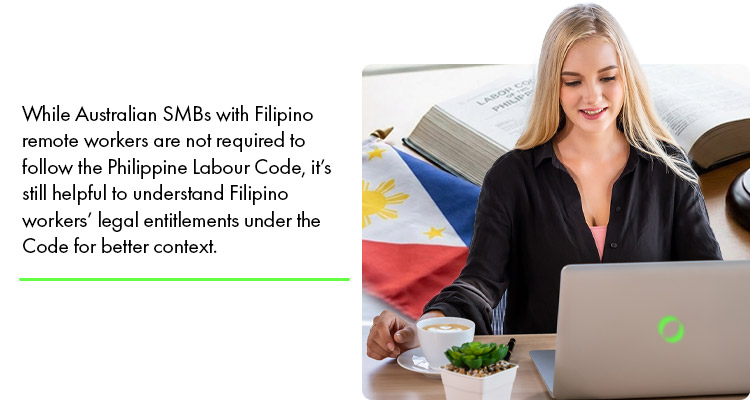
While Australian SMBs with Filipino remote workers are not required to follow the Philippine Labour Code, it’s still helpful to understand Filipino workers’ legal entitlements under the Code for better context.
Let’s take a closer look.
Core Labour Code Provisions
The PH Labour Code is built on the principle of social justice and looks at the labour force as the backbone of the country’s economy. Hence, it mandates the following minimum standards:
- Security of Tenure
- Wages and Compensation
- 13th Month Pay
- Overtime Pay
- Premium Pay for Holiday
- Night Shift Differential
- Working Conditions
- Paid Leaves
- Labour Relations
- Collective Bargaining
- Right to Self Organization
What Applies to AU Employers Hiring Remotely?
Australian employers are only required to provide these minimum benefits if they have a registered office in the Philippines. Without one, they are not covered by the Philippine Labour Code.
However, SMBs must still follow AU’s National Employment Standards (NES) when hiring remote Filipino workers, especially if those workers qualify as regular employees under Australian law. These include:
- Maximum of 38 hours per week
- Leave Entitlements
- Annual leave;
- Personal/carer’s leave;
- Family and domestic violence leave
- Parental leave;
- Termination
- Minimum notice of termination
- Redundancy pay
Employee Classification: Contractor v. Employee
An employee’s classification depends on several factors. In the Philippines, a worker is considered a regular employee if the Four-Fold Test is met, which looks at:
- Selection/Engagement
- Payment of Wages
- Power of Dismissal
- Power of Control
So if the employer hires the worker, pays their salary, can dismiss them, and controls how the work is done, that worker is considered a regular employee under Philippine law.
The Risk of Misclassifying a Worker
The Four-Fold Test does not apply to Australian SMBs hiring Filipino workers remotely under a service contract. However, the FWC may still classify your remote worker as an employee under Australian law. This was the issue in the infamous Joanna Pascua case.
In 2025, Pascua made headlines when the Fair Work Commission ruled that she was an employee, not an independent contractor, for an Australian company. As a result, the company had to pay heavy fines, super charges, legal costs, and deal with public backlash.
Thus, the question: how can you tell if your remote “independent contractor” is really one?
Key Criteria Defined by the Fair Work Commission
Because of the Pascua case, the FWC reminds Australian employers to carefully classify employees using the “Whole of Relationship Test,” which looks at the following:
- Real Substance
- Practical Reality
- True Nature of the Relationship
To find out these three factors, the FWC will look at all parts of the relationship between the parties, including the terms of the contract and what actually takes place in practice.
Hence, they will review:
- The amount of control over how work is performed;
- Financial responsibility and risk;
- Who supplies the tools and equipment;
- Ability to delegate or subcontract work;
- Hours of work; and
- Expectation of work as a going concern.
If the worker meets all these criteria, they are considered an employee of the Australian business. The company must then provide all minimum benefits and withhold taxes under Australian law, even if the worker is based in another country.
Mandatory Employee Benefits for Remote Workers
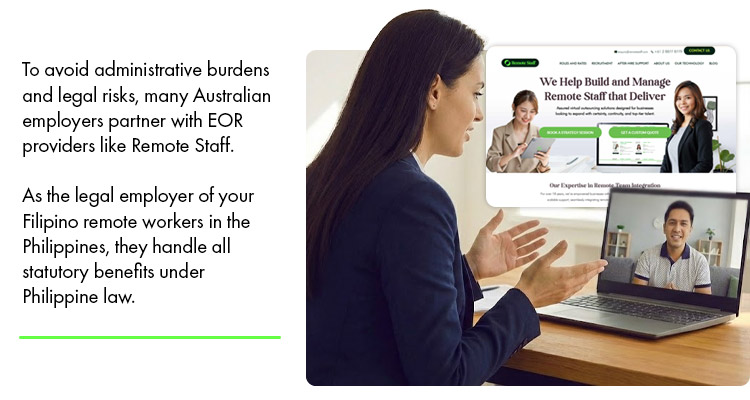
To avoid administrative burdens and legal risks, many Australian employers partner with EOR providers like Remote Staff.
As the legal employer of your Filipino remote workers in the Philippines, they handle all statutory benefits under Philippine law. The EOR cost will cover:
- Employee’s direct compensation;
- Statutory costs; and
- EOR service fee.
Here’s the breakdown of the statutory costs, as required by the PH Labour Code.
SSS, Pag-IBIG, and PhilHealth Contributions
SSS is the mandatory national insurance program that provides retirement, sickness, maternity, disability, and death benefits. Meanwhile, Pag-IBIG provides affordable housing loans, short-term cash loans, and a savings plan.
PhilHealth, on the other hand, is the Philippines’ national health insurance, covering hospitalization, professional fees, and certain medical and surgical procedures.
13th Month Pay and Leave Requirements
The statutory cost also includes the 13th-month pay, an extra payment for employees who worked at least one month in the year. It is paid annually, on or before December 24.
Philippine employers (or in this case, the EOR) must provide five days of paid Service Incentive Leave (SIL) to employees who have worked for them for at least one year. Any unused SIL is converted to cash and paid at the end of the year.
How Employer-of Record Services Handle These For You
Australian SMBs using EORs don’t need to worry about these statutory requirements. The EOR, as the legal employer, handles compliance, and the cost is included in their fees.
Here’s a typical list of all the compliance matters they take care of so you won’t have to:
- Handle statutory contributions;
- Registration
- Calculation and Remittance
- Filing
- Administering 13th month pay; and
- Accurate accrual
- Timely disbursement
- Tax compliance
- Managing leave requirements;
- Service Incentive Leave
- Other statutory leaves
- Maternity
- Paternity
- Solo Parent
Simply put, the EOR handles most administrative and legal tasks, while SMBs focus on growing their core business, with the help of remote workers legally employed by the EOR.

Payroll Tax Obligations for Foreign Employers Operating in the Philippines
Foreign companies are only liable for Philippine taxes if they are considered to be doing business in the country.
Under the Foreign Investments Act, a company is “doing business” when it has a continuing commercial presence or carries out activities that show active business operations in the Philippines.
Thus, an AU company is not liable for Philippine taxes just for hiring remote workers, as long as its operations remain based in Australia.
However, for AU companies that do operate there, here’s what they have to comply with:
- Withholding Taxes – Foreign companies with local branches are required to deduct the correct income tax amount from the employee’s monthly salary. The withheld taxes must then be remitted to the Bureau of Internal Revenue (BIR).
- BIR Form 2316 & 2307 – Companies must file the employee’s annual tax return using BIR Form 2316, showing total pay and income tax withheld for the year.
On the other hand, the BIR requires foreign companies to issue Form 2307 for payments to independent contractors, service providers, or suppliers in the Philippines. The recipients use the tax credit on this form to offset their own income tax.
Labour Law Enforcement: What Foreign Employers Need to Know
The Department of Labour and Employment (DOLE) is the Philippine counterpart to Australia’s Fair Work Commission. It serves as the primary agency responsible for enforcing labour laws and protecting employees’ rights in the Philippines.
When you partner with an EOR like Remote Staff, they handle all DOLE compliance requirements on your behalf.
DOLE Inspections and Remote Worker Claims
The DOLE has the authority to conduct inspections in Philippine-based workplaces to ensure compliance with general labour standards, including wages, benefits, and leave.
They also handle illegal dismissal complaints filed by aggrieved employees, including claims for backwages, reinstatement, and separation pay.
How Remote Staff Minimises Your Legal Exposure
The benefit of partnering with an EOR is not to avoid Philippine laws – especially since AU employers with no business operations there are not directly liable for PH tax or labour regulations in the first place.
Rather, the EOR acts as a legal safeguard that protects Aussie employers under Australian laws, particularly by preventing employee misclassification.
By formally designating your remote workers as employees of the EOR, you avoid the risk of the Fair Work Commission or the ATO probing your business for tax or labour compliance issues.
Remote Staff’s Solution: Compliant Hiring Without an Entity
For the last 18 years and counting, Remote Staff has been supporting Australian employers with their remote staffing needs. As an EOR, they offer the following:
Contractor-on-Record for Project-Based Talent
A Contractor-on-Record (COR) is a business-to-business arrangement where Remote Staff assists you with the payroll and documentation requirements of your independent contractor. The focus is primarily on compliance, including:
- Managing payroll;
- Issuing the necessary tax documents to assist the contractor with their tax returns; and
- Fulfilling other administrative compliance requirements.
Under this setup, the AU employer remains liable if the independent contractor is later deemed an employee under Australian law.
EOR Basic for Long-Term, Full-Time Staff
On the other hand, if you want a full-time arrangement with your remote workers, using Remote Staff’s EOR services is the better option.
Remote Staff becomes the legal employer of your staff in the Philippines. This means your Filipino remote workers are officially employees of Remote Staff, enjoying full job security and statutory rights under the Philippine Labour Code.
They will handle and ensure compliance with the following:
- Processing monthly payroll;
- Calculating and remitting all taxes and mandatory contributions; and
- Ensuring employees receive 13th-month pay and other mandatory paid leaves.
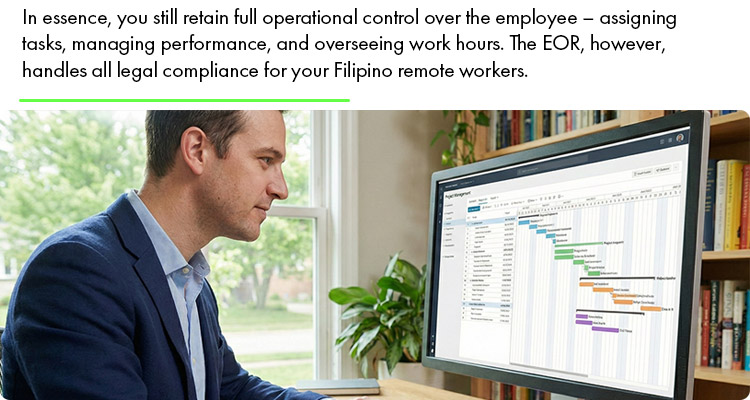
In essence, you still retain full operational control over the employee – assigning tasks, managing performance, and overseeing work hours. The EOR, however, handles all legal compliance for your Filipino remote workers.
Fast Setup and Full Payroll Compliance
Since you already have remote workers, implementing an EOR setup is faster than an arrangement where Remote Staff would need to recruit and hire employees for you.
Here’s how it works:
- Sign up and specify your requirements.
- Indicate the number of employees you need covered.
- Receive a quote from Remote Staff for a monthly or percentage-based EOR service fee per employee.
- Choose the setup that works best for you.
- Remote Staff will then handle onboarding, administrative tasks, and payroll compliance.
Frequently Asked Questions (FAQs)
Here are some frequently asked questions regarding tax and labour matters for Australian employers hiring Filipino remote workers.
#1. What Labour Laws Apply to Filipino Remote Workers Hired by AU Companies?
If a remote worker is employed directly by an Australian company, Australian labour laws apply. However, if the worker is employed through an EOR, Philippine labour laws govern their employment.
#2. Can I Hire a Contractor Instead of An Employee To Save Costs?
Yes, however, this can expose your company to the risk of employee misclassification. In the recent Pascua case, the plaintiff was hired as a contractor, but the nature of her work resembled employment rather than a service contract.
As a result, the Australian company that hired her was held legally liable for unpaid taxes and superannuation contributions, in addition to fines and legal costs. While hiring a contractor may seem cost-effective initially, it can become expensive over time if you aren’t careful.
#3. Am I Responsible for Payroll Taxes as a Foreign Business?
No, not if you have an EOR in place. As the legal employer, the EOR handles withholding and remittance of income taxes in the Philippines.
You also don’t need to worry about Australian laws, since the arrangement is between you and the EOR, not directly with the remote worker.
#4. What Happens If I Misclassify a Remote Worker?
Under Australian laws, you will be liable for the following:
- Penalties and fines;
- Back payments;
- Superannuation with administration fee and nominal interest;
- Leave entitlements; and
- Unpaid payroll tax.
These are on top of the reputational damage resulting from the negative media coverage and public backlash.
#5. How Can I Ensure I’m Compliant Without Opening a PH Entity?
Australian employers are increasingly shifting from direct hiring to partnering with an EOR like Remote Staff. Since the EOR is registered in the Philippines, this fulfills the legal requirement for an employer to operate within the country.
Moreover, you can be confident that your Filipino remote workers are paid accurately and legally, without your company being liable for misclassification in either the Philippines or Australia.

Stay Compliant with Labour Laws – Without the Legal Headaches
Filipino professionals continue to be among the most in-demand employees, regardless of their location. Despite the distance, many Australian employers prefer to work with them due to their quality and cost-effectiveness.
Fortunately, there is a legal and ethical way to achieve this, without any undue hassle or stress on your part.
Through Employers of Record such as Remote Staff, you can take comfort in knowing that you are providing your remote workers with job security under Philippine law, while simultaneously protecting your company from any legal issues under Australian law.
For more information about EOR services, book a free consultation now.

Syrine is studying law while working as a content writer. When she’s not writing or studying, she engages in tutoring, events planning, and social media browsing. In 2021, she published her book, Stellar Thoughts.