

Remote hiring has become one of the most practical options for employers today. Thanks to the internet, talent is no longer confined to a specific location. No matter where you are, you can access world-class professionals at highly competitive rates.
However, the blurring of time zones and jurisdictions has led to legal confusion. Which tax rules should apply? How should remote workers be classified when they work for a foreign employer but remain based in their home country?
This is where an Employer of Record (EOR) comes in as the legal solution to numerous global hiring challenges.
In this article, we will explore why and how EORs make it easier for small and medium-sized businesses (SMBs) to hire globally – legally and ethically.
Read on to know more.
What is an Employer of Record (EOR)?
An EOR is a third party that serves as the legal employer of remote workers. As such, it manages key administrative functions, including payroll, benefits, taxes, labour requirements, and other regulatory compliance.
How Does an EOR Work for Global Hiring?
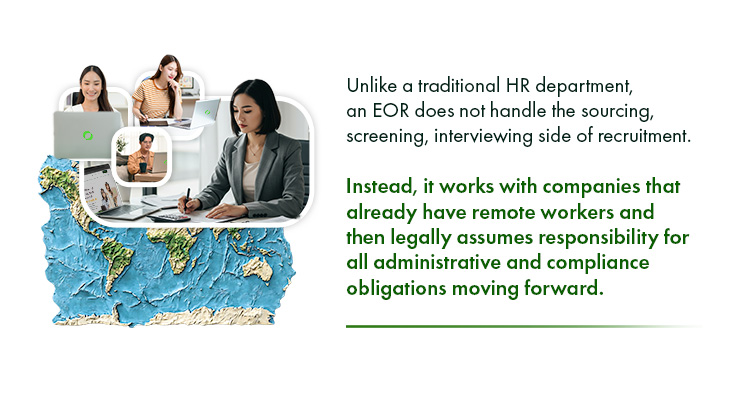
Unlike a traditional HR department, an EOR does not handle the sourcing, screening, interviewing side of recruitment.
Instead, it works with companies that already have remote workers and then legally assumes responsibility for all administrative and compliance obligations moving forward.
This creates a tripartite relationship among the business, the remote employee, and the EOR. The business retains day-to-day management, while the EOR handles all legal and administrative complexities.
For example, an Australia-based tech company may hire a software developer in the Philippines even without having a local office there. Instead of setting one up or letting the employee go, the company can tap an EOR in the Philippines to serve as the developer’s legal employer – while the AU company still manages the developer’s tasks and performance.
Why do companies consider hiring under an EOR Model?
1. Legal Compliance Without the Legal Headaches
Each country has its own rules for employment, taxation, benefits, leave entitlements, and termination. For businesses without a local entity, even a small compliance error can lead to penalties, audits, or legal disputes.
An EOR absorbs these risks by ensuring every hire complies with the worker’s local labor laws.
2. Faster Global Hiring Without Setting Up a Local Entity
Setting up a company abroad requires months of paperwork, government registrations, legal consultations, and ongoing reporting obligations.
An EOR removes that barrier by serving as the local employer—allowing companies to hire immediately and legally within days, not months.
3. Reduced Costs and Administrative Burden
Managing payroll, statutory contributions, government filings, employment contracts, and HR administration across multiple countries is costly and time-consuming.
EORs consolidate all of these into one streamlined process so businesses can focus on productivity, not bureaucracy.
4. Risk-Free Workforce Expansion
Companies often want to “test” a market or remote role before committing long-term.
An EOR allows them to scale up or down without the financial exposure that comes with establishing foreign subsidiaries or misclassifying workers.
5. Protection From Worker Misclassification
Globally, many companies unknowingly violate labor regulations by classifying full-time workers as contractors.
An EOR ensures proper classification, preventing disputes, back-pay obligations, tax issues, and reputational harm.
6. Better Employee Experience and Retention
Remote workers hired through an EOR receive the correct benefits, statutory contributions, compliant contracts, and timely payroll.
This builds trust, improves engagement, and enhances retention—especially in competitive markets.
7. Seamless HR and Payroll Operations Across Borders
An EOR becomes the single point of contact for payroll, timekeeping validations, government remittances, and documentation.
This eliminates the operational load on internal HR teams and ensures smooth, predictable workforce management.
EOR vs. PEO vs. Contractor-on-Record: What’s the Difference?
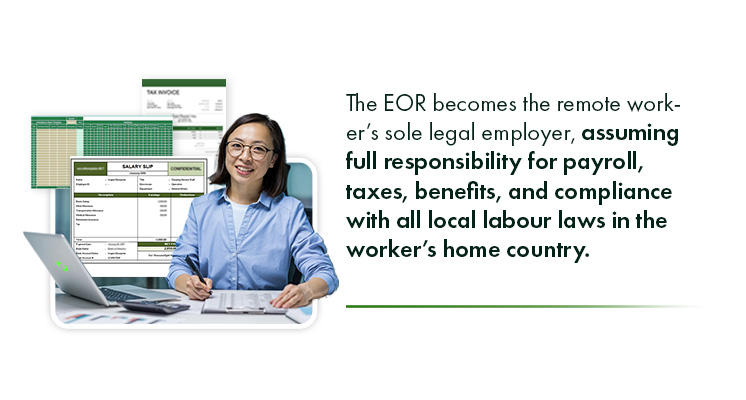
The EOR becomes the remote worker’s sole legal employer, assuming full responsibility for payroll, taxes, benefits, and compliance with all local labour laws in the worker’s home country.
On the other hand, a Professional Employer Organization (PEO) operates under a co-employment model. This means your company must already have a legal entity in the country where your remote worker is based and will remain the official employer. The PEO simply shares HR responsibilities, such as payroll and benefits administration.
Meanwhile, a Contractor-on-Record (CoR) manages the engagement and payment of independent contractors. There is no employer-employee relationship, but the CoR ensures the worker is correctly classified as a contractor, helping prevent legal misclassification like in the Joanna Pascua case.
In other words, the EOR assumes full legal responsibility, a PEO shares certain administrative duties, and a CoR ensures compliance with regulations.
Why Pricing Transparency Matters in EOR Services
The efficiency and practicality of EORs have led many companies to shift legal responsibilities to third parties. However, this is easier said than done, particularly because finding the right EOR, especially at the right price, can be challenging.
Hidden Fees in Traditional EOR Models
EOR tasks can be complicated, especially for SMBs unfamiliar with legal and labour requirements. As a result, business owners may struggle to determine which pricing model is the most suitable.
Many third parties use complex, non-transparent pricing with hidden fees. They may advertise low costs to attract companies, only to later charge higher expenses due to undisclosed fees covering:
- Setup or onboarding fees;
- Currency exchange markups;
- Termination or offboarding fees; and
- Benefits administration fees.
Cost Implications of Non-Compliance in the Philippines
Thousands of SMBs in Australia are hiring skilled remote workers from the Philippines. However, direct hiring can be tricky, particularly if the Australian company misclassifies the remote worker.
In the Pascua case, the company classified Pascua, a Filipino remote worker, as an independent contractor.
However, the Fair Work Commission ruled that she was, in fact, a regular employee based on her tasks, relationship with the company, and other factors. This led to hefty fines, a costly legal battle, and negative publicity for the company.
Similarly, non-compliance with Philippine labour laws can lead to severe costs and legal risks. Direct hiring without following the proper legal process may result in penalties, back wages, and legal fees in the Philippines and even in Australia.
As a result, many Australian employers partner with Remote Staff, an EOR that has been helping Aussie companies work with Filipino workers for over 18 years.
Acting as the legal employer of your remote workers, Remote Staff ensures compliance with Philippine labour laws, including expanded maternity leave and contributions to SSS, PhilHealth, and the PAG-IBIG Fund.
EOR Pricing Breakdown (Philippines)
Here is a breakdown of typical pricing when partnering with an EOR for remote workers in the Philippines:
Common Pricing Models Used by Providers
The EOR industry typically uses two primary pricing models.
| Fixed Monthly Fee | Percentage of Gross Payroll |
| The company pays a fixed monthly fee per employee.
For example, AUD $599 per employee per month. |
The EOR charges a percentage, typically 10–20% of the employee’s total gross monthly compensation. For example, a 15% EOR fee on an employee earning AUD $3,000 per month would be AUD $450. |
A fixed monthly fee makes budgeting easy since it doesn’t change with raises or bonuses. However, it can be high for lower-salaried roles or in low-cost markets.
On the other hand, the percentage model scales with the employee’s salary, making it cost-effective for junior or lower-paid roles. However, costs can become unpredictable since the fee rises whenever the employee gets a raise or bonus.
What’s Included in EOR Fees (vs. Not Included)
The standard EOR service fee covers the following:
- Legal employment liability;
- Onboarding and offboarding;
- Monthly payroll administration;
- HR support and guidance; and
- Tax filing and compliance.
However, the following fees are shouldered by the AU company:
- Gross salary;
- Statutory employer taxes;
- Employee benefits;
- Expense reimbursements; and
- Currency conversion (FX) fees.
Average Cost Ranges for Hiring in the Philippines
The total cost of hiring Filipino remote workers through an EOR consists of two main parts: the EOR service fee and the statutory costs (pass-through).
As mentioned earlier, the Employer of Record pricing depends on whether you choose a fixed monthly fee or a percentage-based model. Meanwhile, statutory costs under Philippine law include:
- Gross monthly salary;
- 13th month pay;
- Social security;
- PhilHealth;
- Pag-IBIG Fund; and
- Income tax.
EOR Pricing Comparison (Philippines vs. Global)
Here’s how Philippine-based EORs like Remote Staff compare with those in other countries:
Philippines vs. India, LATAM, and Eastern Europe
Filipino workers are among the most in-demand remote talent, alongside professionals from India, Latin America, and Eastern Europe, as shown in the following matrix:
| Philippines | India | LATAM | Eastern Europe | |
Primary Focus Skill |
Voice-based BPO, customer service, virtual assistants, finance/accounting | IT outsourcing, software development, data analytics, engineering | Nearshoring tech talent, digital marketing, customer success | Software development, engineering, research and development |
| Time Zone Alignment | -3 to -4 hours behind AU | -4.5 to -5.5 hours behind AU | -12 to -15 hours behind AU | -8 to -9 behind AU |
How Location Affects Pricing and Compliance
While other countries also offer competitive talent, many Australian employers prefer Filipino remote workers because of the small time difference of 3–4 hours.
This means workers don’t have to work night shifts, unlike in Latin America or Eastern Europe, which also helps reduce costs when hiring through a Philippine EOR.
How Remote Staff Offers a Competitive Edge
Remote Staff has supported over 3,000 business owners with their staffing needs. Drawing on its expertise in both the Australian market and Philippine labour laws, it has expanded to provide EOR services.
18 Years of Local Expertise
As a Philippine-based EOR with strong ties to Australia, Remote Staff has a deep understanding of the nuances of both Philippine and Australian laws and regulations.
Its working model has been tested and refined since the early days of global remote work.
With nearly two decades of experience, Remote Staff has mastered the legal requirements of both countries, with particular expertise in Philippine labour laws and taxation.
Hybrid EOR and Contractor Conversion Solutions
Remote Staff offers hybrid EOR and contractor conversion solutions to ensure legal compliance for tax purposes while reducing the risk of employee misclassification, a common issue in global hiring.
The hybrid model streamlines operations instead of needing separate vendors for:
- Payroll processing;
- Legal employment; and
- Contractor payments.
Moreover, its contractor conversion service allows you to transition your current independent contractor into a full-time employee under Remote Staff’s EOR model.
This dual approach greatly reduces administrative burdens and legal risks under both Australian and Philippine law, as Remote Staff serves as the legal employer of your remote workers in the eyes of both countries.
Full Compliance with Philippine Labour Laws
The Philippine government, through the Department of Labour and Employment (DOLE), oversees companies’ compliance with the country’s Labour Code.
Consequently, as the EOR and legal employer, Remote Staff ensures your remote workers receive all legally mandated benefits and entitlements.
Frequently Asked Questions (FAQs)
Here are some frequently asked questions about working with EORs.
#1. What Does EOR Cost Include?
The total cost of employment through an EOR includes the EOR service fee (either a fixed monthly rate or a percentage) and pass-through costs such as the employee’s gross salary, statutory contributions, and taxes.
#2. Are There Setup Fees for Using an EOR in the Philippines?
It depends on the provider.
For example, Remote Staff typically charges an all-inclusive fixed EOR monthly fee breakdown (Philippines) and provides a transparent pricing breakdown, so you know the cost of services upfront of hiring Filipino remote workers.
#3. How Is the Total Cost Per Employee Calculated?
Generally, the total cost per employee is calculated by adding the employee’s direct compensation, statutory costs, and the EOR service fee.
For example, if an Australian company hires a Filipino worker with:
- AUD $1,000 – Monthly salary
- AUD $150 – Statutory contributions (SSS, PhilHealth, Pag-IBIG)
- AUD $200 – Fixed EOR monthly fee
The total cost for the company would be AUD $1,350 per month for this specific employee.
#4. How Long Does Onboarding Take?
The onboarding process with an EOR is much faster, as there’s no need for vetting or interviews. The employees are already in place, and you simply transition their employment status to the EOR.
With Remote Staff, the Australian company only needs to specify its requirements. They provide suitable options and quotes, and once approved, handle all administrative and regulatory responsibilities, typically within 1–2 weeks, depending on the agreement and turnaround times.
#5. What Happens If I Want to Convert My Contractor To an EOR Employee?
The EOR assumes the employment relationship by first assessing the worker’s current role. It then calculates and proposes the appropriate rate per employee.
Once approved on your end, the EOR drafts a new employment contract with itself as the employer. After the remote worker signs the contract, the EOR legally becomes the employer of record, taking on all associated legal responsibilities.
Conclusion: Choose the Right EOR Partner
The internet has made it easier to take businesses global, making international hiring essential for competition. Fortunately, working with diverse teams across physical and digital spaces has become easier to manage.
With EOR providers like Remote Staff, you don’t need to decide between setting up a local entity or hiring a candidate closer to home.
Now, you can hire top talent at competitive rates without worrying about legal requirements.
This reduces your mental load, letting you focus on growing your business while ensuring your remote workers receive all legally mandated benefits – without the stress falling on you.
So, what are you waiting for?
Book a free consultation now for a transparent EOR cost breakdown.

Syrine is studying law while working as a content writer. When she’s not writing or studying, she engages in tutoring, events planning, and social media browsing. In 2021, she published her book, Stellar Thoughts.