

When should you use no-code platforms, and when are they not enough?
No-code platforms are ideal for validating ideas, building internal tools, and launching simple applications quickly without a large development budget. They become less suitable when your project involves complex integrations, sensitive customer data, advanced workflows, or long-term growth that requires greater flexibility. The right choice depends on your business goals, the complexity of your app, and how much you’ll need it to evolve over time.
Someone in your network built an app in a weekend. Maybe you saw the LinkedIn post like so:
“I vibe-coded my SaaS to $10K MRR in 30 days. No developers needed.”
Now you’re looking at your own product idea, and hiring one no-code builder or vibe coder looks like the obvious move. Cheaper than a dev team. Faster than a traditional build. The way you see it, and with all those comments on socials, everyone’s trying it out.
Then, you come across: “Limitations of no code platforms.” “Disadvantages of vibe coding.” Only, it’s not very clear what the pages meant by that.
Here’s what isn’t explained just as much: you’d be handing your entire product (the thing your business will depend on) to one person and an AI tool. You’ll be betting they can single-handedly cover architecture, security, integrations, testing, and years of maintenance.
Is it all hype then? Not really. What no code is? It’s exactly what they say it is. It does what they say it does. There’s just a mismatch of expectations, or a less-than-clear description of what happens after.
So what are you actually signing up for when you hire a vibe coder or no-code developer instead of a team? Should you use no-code platforms? Let’s break down what the vague statements leave out.
In This Blog:
- ➤What Are the Limitations of No Code: The Pitch That’s Everywhere, and Also Nowhere, Right Now
- ➤What You’re Getting When You Hire a “Vibe Coder” (Pros and Cons of No Code)
- ➤Layers the No Code Hype Conveniently Skips (Plus What to Ask a No Code Developer)
- ➤Three Ways This Goes Wrong: What Are the Risks of Vibe Coding, Really?)
- ➤When a Vibe Coder or No-Code Tool Is the Right Call (What Are the Benefits of No-Code Platforms?)
- ➤FAQs About the Limitations of Vibe Coding Tools and Vibe Coding Risks
- ➤Matching Your Projects With the Right Talent
What Are the Limitations of No Code? (Disadvantages of Vibe Coding)
You’ve heard some version of this: let AI tools or no-code app development platforms generate the code, and ship a working product in days (mobile app, workflow automation tool, etc.). The no-code development approach. No computer science degree required. No expensive dev team on payroll. Just you and a chatbot. And your vision.
That’s the development process.
Vibe coding’s a real term coined in early 2025 to describe building software by describing intent to an AI without writing code by hand. It has genuinely compressed the time it takes to get a rough prototype in front of users.
No-code platforms offer, and have done, the same for years. Platforms like Bubble, Webflow, and Glide have let non-technical founders assemble simple apps through drag-and-drop interfaces and visual development. Cost-wise, a freelance vibe coder or no-code builder typically runs a fraction of what a development team costs.
The no-code solutions pitch is half true. (Here’s our insider take on the advantages of No-Code Development)
It’s true for a landing page or an internal tool. True for a scrappy prototype you’re using to test demand. It stops being true the moment your product needs to handle real, from customers, to money, to data. Traditional development / traditional software development. Exactly the point at which most SMB owners make the hire in terms of what the platforms often provide or lack, and what their business actually needs.
What Are the Pros and Cons of No Code: What You’re Getting When You Hire a “Vibe Coder”
Vibe Coder. No Code Developer. What do the terms mean in practice?
A vibe coder guides an AI model through natural-language prompts, reviews what it generates, and nudges it toward a working result, without necessarily reading or understanding the underlying code line by line.
A no-code developer does something similar using visual builders instead of a programming language.
Neither is writing software the way a trained engineer does. Both are directing a tool.
No Code Developer vs Software Developer
A trained developer can tell you why a piece of code will break under load or where a security hole’s hiding. How a database schema will hold up at 10,000 users.
Vibe coders are often reviewing AI output without the background to catch what’s wrong with it. A large share of people doing this work today are non-developers: marketers, founders, designers, and product managers who’ve never shipped production software before.
Illustration: Maxine, who runs a 12-person accounting firm, hires a vibe coder off a freelance marketplace to build a client portal where customers upload tax documents. They chose from no-code applications, and the vibe coder went to work. The demo looks great in the interview.
Three weeks later, the portal is live. A client accidentally sees another client’s uploaded documents because the access permissions weren’t properly scoped.
Maxine finds out from an angry email instead of from a bug report. Nobody on the build was equipped to catch it before launch.
Related Read: Learn more about the role and what tools they use: Best No-Code App Development Platforms.
Layers the No Code Hype Conveniently Skips (Plus What to Ask a No Code Developer)
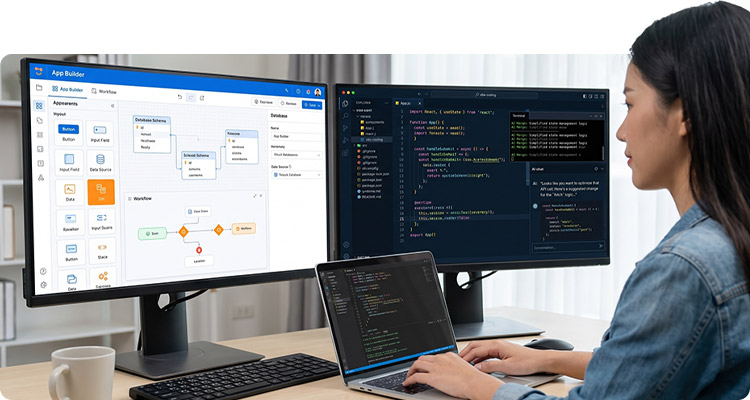
Is a real software product one layer? What are the challenges and limitations of no code development tools? It’s several, stacked on top of each other, each one requiring a different kind of expertise.
Here’s what a single vibe coder or no-code developer is being asked to cover alone, and why that’s a heavier lift than the pitch admits.
1. Architecture and Data Modeling
Every app is built on decisions about how data is structured, stored, and connected. Decisions that are cheap to make correctly on day one; brutally expensive to unwind later. A prototype doesn’t expose bad architecture, but growth does.
What To Do: Before any building starts, ask whoever’s building your product to explain, in plain terms, how they’re structuring your core data (users, transactions, records). Ask why. If they can’t answer clearly, that’s your answer.
Illustration: A retail startup’s no-code inventory app worked fine with 200 SKUs. At 3,000 SKUs and multiple warehouses, the flat data structure the builder used couldn’t represent stock-by-location. So, the founder had to pay for a full rebuild. This time, with a developer who modeled the data correctly from the beginning.
2. Security and Compliance
Recent analysis of AI-generated code found a large share contains real vulnerabilities. Hardcoded secrets. Injection flaws. Access-control gaps. That AI-written code is meaningfully more prone to these issues than code written by an experienced engineer who’s reviewing for them.
What To Do: Require a security checklist before launch: encrypted data storage, proper authentication, role-based access controls, and a documented answer to “what happens if this account gets compromised?” If your build process has no answer to that question, don’t launch yet.
Illustration: A wellness clinic’s booking app is built entirely through a no-code platform. However, it stored patient notes in a field visible via a public API endpoint nobody had locked down. It went unnoticed for four months, until a routine review by a new hire caught it.
3. Integrations and Future Expansion
Your app needs to talk to your payment processor, your CRM, your email tool, and maybe your accounting software. No-code platforms handle simple integrations well. The moment you need custom logic, real-time syncing, or high transaction volume, they struggle.
What To Do: Map every system your product needs to connect to today. Include every system you’re likely to need in 18 months. If more than two or three involve custom business logic, you’re outside what one no-code builder can comfortably support.
4. Quality Assurance and Testing
Someone who builds fast rarely has the bandwidth or the training to test thoroughly. Formal testing (edge cases, load testing, regression checks after every change) is its own discipline, distinct from building.
What To Do: Ask directly who is testing the product. Follow it up by asking who built it. “I tested it myself,” from the same person who wrote it, is not a QA process.
5. Ongoing Maintenance and Technical Debt
The build is the beginning, not the end. Every update, every new feature, every platform change creates a chance for something to break. Vibe-coded and no-code products in particular tend to accumulate what’s best called “invisible debt” — quick fixes stacked on quick fixes, invisible until the whole thing buckles.
What To Do: Ask what happens when your builder is unavailable. If the honest answer is “nobody else can maintain this,” you don’t have a product. You have a dependency.
Extra Read: No code is making waves. But so is Australia’s renewables sector. Find business opportunities in— Solar Farm Lease Australia Guide and Floating Solar Panels Australia.
What Are the Risks of Vibe Coding, Really? (Three Ways This Goes Wrong)
The Weekend Wizard. This is the builder who’s genuinely talented at fast prototypes and gets hired for a production system anyway. The demo’s dazzling. But the foundation underneath is a house of cards. You find out the hard way that speed and durability aren’t the same skill.
The Vanishing Vibe Coder. Freelance vibe coders and no-code builders are often solo operators juggling multiple clients. When they move on (and they do), you’re left with a system nobody else can read. A system no one in your team can understand, or safely modify.
The No-Code Ceiling. This one doesn’t look like failure. Not at first. Everything works, right up until you need a feature that the platform simply can’t support. Real-time data processing. Custom machine learning logic. Complex permission structures. You discover the ceiling only after you’ve built your business on top of it.
Your speed got you to market. Shortcuts, a working demo. But your ceiling? It’s what stops you from ever growing past it.
Related Read: Find out what your numbers really are as you plan the hire. Use our Free Outsourcing Calculator below:
When a Vibe Coder or No-Code Tool Is the Right Call
What Are the Benefits of No-Code Platforms?
None of this means the tools are bad, only that they’re being sold as something they’re not.
Vibe coding and no code platforms are genuinely excellent for validating an idea before you spend real money. Before building an internal tool that nobody outside your team will ever touch. They’re the way in prior to standing up a marketing page in an afternoon.
If the cost of that system failing is “we redo it,” a single builder is a smart, cheap way to move fast.
When trying to get the right answers to “vibe coding vs traditional development” or “no-code developer vs software developer,” it boils down to this:
The moment customer data, payments, compliance requirements, or business-critical operations enter the picture, the calculation changes. What was a smart shortcut for a prototype becomes a serious liability for a product.
Find out what your numbers really are as you plan the hire. Use our Free Outsourcing Calculator below:
Matching Your Projects With the Right Talent
There’s a middle path most SMB owners never get shown when it comes to choosing between an expensive in-house engineering department and a solo vibe coder. In fact, choosing a side isn’t it at all.
A properly staffed, fully managed remote team that covers the layers a single builder can’t. All without the overhead of a full local hire.
That’s where Remote Staff comes in. Instead of betting your product on one person’s availability and one person’s blind spots, you get matched with vetted remote developers, QA specialists, and project managers built around what your app actually needs.
At a fraction of the cost of a local team. With none of the recruitment legwork on your end.
Extra Read: Stay compliant in all areas of your business. Find out about Modern Slavery Australia and Payday Super Rules.
FAQs About the Limitations of Vibe Coding Tools
Can a vibe coder really build my entire app by themselves? (what are no-code platform limitations?)
They can build a working version, especially for something simple. What they usually can’t do alone is secure it, scale it, integrate it properly with your other systems, and maintain it for years; those require different, often multiple, skill sets.
What’s the difference between a no-code developer and a professional software developer? (Is a software developer the same as a coder?)
A no-code developer assembles pre-built components inside a visual platform. A professional developer writes and architects custom code and understands what’s happening underneath the interface. Developers can diagnose problems drag-and-drop tool will ever surface.
Is no-code good enough for a revenue-generating business? (Can no-code support any business?)
It can be, for simple internal tools or early-stage MVPs. It’s rarely enough once you’re handling customer payments, sensitive data, or workflows that need to scale past a few hundred users.
How do I know if I need to use no-code platforms or no-code solutions? (What are the disadvantages of no code platforms for businesses?)
If your product touches money, personal data, multiple third-party integrations, or needs to serve more than a few hundred concurrent users, it’s past the point where one person on one tool can safely cover everything.
What should I ask a vibe coder or no-code developer before hiring them? (Questions to ask when choosing a no code developer)
Ask who handles security review. What happens if they become unavailable? How do they test before launch, and whether they’ve shipped something with similar requirements in size and complexity?
What is low-code development? (What are low-code development platforms?)
Low-code development or “low code development’ uses visual tools, drag-and-drop components, and a small amount of coding to build software faster than traditional development. Low-code development platforms help developers and technical teams create custom applications while still allowing them to write code when advanced features or integrations are needed. Unlike no-code platforms, low-code tools are designed for projects that require greater flexibility and customisation.
What is the difference between low-code and no-code development? (Are low-code and no-code platforms the same?)
No-code platforms are designed for users with little or no programming experience, building applications using visual, drag-and-drop tools. Low-code platforms also use visual builders but require some coding to customise features, integrations, or complex workflows. In general, no-code is best for simpler applications. Low-code offers more flexibility for larger or more complex projects.
Your App Isn’t a Weekend Project
The no-code hype was never wrong about the demo. Everything after, possibly, because there isn’t one side. It isn’t just about the limitations of no-code or the benefits of no-code. There’s middle ground in the confusion, and that’s your advantage.
A vibe coder or no-code developer can get you a fast prototype; a real team is what turns that prototype into something your business can actually stand on.
You’ve got the idea. Now make sure the team behind it can carry the weight.
Request a Callback from Remote Staff to talk through what your project actually needs.

Vaune Everis Cura has always been a writer in the truest sense, drawn to the art both as a personal creative pursuit and as a profession. Her experience penning content across digital marketing spaces and collaborating with business owners and market shapers has broadened her craft to include strategic direction and SEO insight. Having spent years with the InterContinental Hotels Group before stepping boldly into freelancing, she understands that at the centre of it all are genuine, meaningful brand–customer relationships built on purposeful, human content.