
In This Blog:
- ➤Evaporation and Your Dam: When It’s Not As Simple As Water Going Away
- ➤What Is the Warrnambool Project? (Why Is It Important?)
- ➤Why the Government Is Backing Floating Solar on Farm Dams
- ➤Which Farm Operations Are Best Positioned Right Now
- ➤FAQs About Floatovoltaics
- ➤Who Runs the System After It’s Installed?
- ➤Dams Are Losing Water. Will You Lose Your Source of Income, Too?
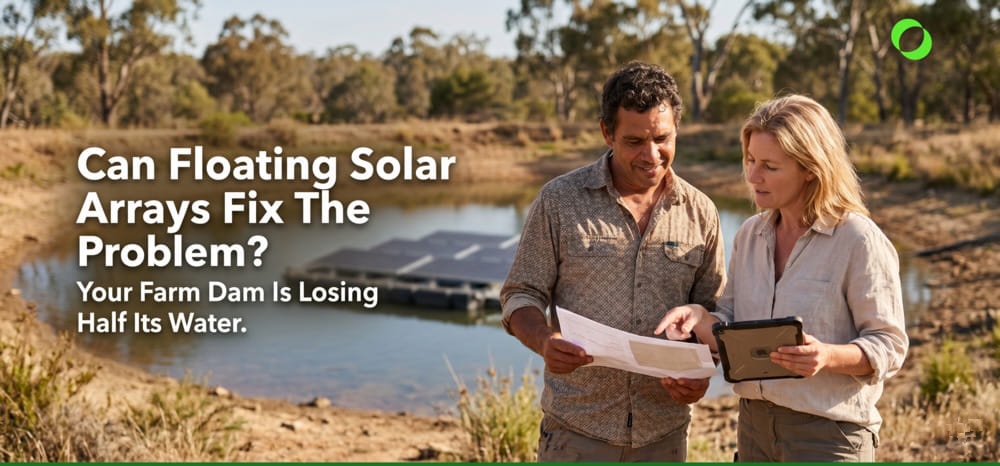
Water allocations in Australia are tightening. Energy costs are rising. And every year, around half of stored on-farm water may never reach productive use due to evaporation. (CRDC/NEESTI data)
But there’s a niche, energy-generating technology that can both save the dam and give it a second function:
Floating solar panels or floating solar arrays.
As evaporation continues to draw water levels down, and nature, not always returning water as predictably as farms rely on, here’s what other farm owners are doing:
They’re talking to the right people about transforming their agricultural irrigation dams into sites for floating photovoltaics.
The on-farm dam becomes a part of the solar energy generation system. And that same energy it produces can power the farm’s own irrigation pumps.
This article explains how an irrigation dam becomes a floating solar site to generate clean energy, protect stored water, and create a second source of income.
What are floating solar panels in Australia? (Do floating solar panels work?)
Floating solar panels (also called floating solar arrays or floating photovoltaic systems (FPV) are solar energy systems installed directly on bodies of water instead of land. They sit on floating support platforms and generate electricity the same way conventional solar panels do: by converting sunlight into usable power through photovoltaic (PV) cells. Their main purpose is still energy generation, but floating arrays come with a second benefit: they shade the water beneath them, helping reduce evaporation while the water itself cools the panels and improves performance. Because they use existing water infrastructure rather than productive land, floating solar is becoming increasingly attractive for farms, reservoirs, and irrigation systems. Even land with lakes, ponds, and similar bodies of water.
Evaporation Control Farm Dams Solar: What Is a Floating Solar Array? (What Are Floating Solar Panels?)
50% of on-farm water storage volume dissipating into the atmosphere year after year doesn’t seem that alarming to some. Because, like evaporation, water replenishment is part of the natural hydrological cycle, too.
The scientific explanation behind water movement suggests as much. Rainfall. Surface runoff. Channels. Diverted flows. These are a few of the inflows that refill agricultural irrigation dams.
However, there’s a looming concern hidden in seemingly calm waters: replenishment isn’t happening as much as, nor as often as, farmers and agriculture businesses are counting on it to. And when water levels don’t rise back the way they once did, neither does the level of production the farm depends on.
More numbers that shed light on the matter:
- In NSW and Queensland, evaporative losses from irrigation water storage total approximately 1,320 gigalitres annually (The Energy)
- For cotton growers whose operations rely heavily on storing and moving water, electricity, and diesel account for up to 50% of total input costs (energy.gov.au)
- Irrigated crop farmers spend AU$150–280 per hectare, per year, on electricity for water pumping (Sustainable Future Australia)
The Turn of the Tide
But did you know that if farmers could prevent just 10% of on-farm storage evaporation loss and send that flow back to crop production, the economic benefits are enormous?
AU$41 million-enormous.
Installing an innovation in solar, floating photovoltaics (FPVs), also called “floatovoltaics,” on irrigation dams is one of the ways that can make it happen.
More stored water → more water available for irrigation → more irrigated area → higher efficiency and crop yield → better capacity and agricultural returns
FPVs typically add a second function to existing irrigation infrastructure rather than take farmland out of production.
Floating solar panels in Australia can generate income by lowering electricity bills, reducing water losses from evaporation, and, in some cases, exporting surplus solar power back to the grid. How much you can make depends on your dam size, system capacity, local electricity prices, and whether your property qualifies for renewable energy incentives. For many irrigators, the biggest financial gain comes from combining lower operating costs with more productive water storage rather than relying on electricity sales alone.
What To Do: Multiply your on-farm storage capacity (in megalitres) by 0.5 to get a rough estimate of how much your on-farm dam loses water prior to the growing season. Multiply that by your water entitlement price today, and you arrive at an AU amount you can add to your seasonal or annual floating solar cost base.
What Is the Warrnambool Project? (Why Is It Important?)
The Australian-owned developer, Enervest, completed a 500kW floating solar array at the Brierly Basin reservoir in Warrnambool, Victoria, in 2026. It did so on behalf of Wannon Water (a regional urban water corporation owned by the Victorian Government).
The array uses 1,260 bifacial solar modules. That equates to 500kW capacity, which is estimated to generate over 600,000 kWh annually. It’s now the sole source that powers the water treatment plant entirely. The entire system is set to contribute to greenhouse gas emissions reduction by over 650 tonnes per year.
Total project development and estimated cost is AU$2 million.
This project is technically on public water infrastructure. Even so, the same technology is being tested on irrigation storage across five agricultural sectors:
Cotton, rice, sugar, horticulture (fruit, vegetables, nuts, etc.), and dairy.
Extra Read: Australia’s Solar Panel Recycling time bomb and Queensland Construction Worker Shortage are about to explode. Here’s how not to get caught in the impact, and what business opportunities await those who get to the starting line first.

Why the Government Is Backing Floating Solar on Farm Dams
The Australian government is all-in on FPVs on agricultural irrigation dams. Otherwise, it wouldn’t have committed AUD 6 million in funding towards a research initiative under the NEESTI program. It wouldn’t have backed research programs for the technology if there weren’t plans to apply them in the field.
What Is NEESTI? The Pioneering Project Behind It
The Novel Energy and Evaporative Storage Technologies for Irrigators (NEESTI) project is a AU$13-million, five-year initiative that launched in June 2025. Of that amount, AU$6 million came from the Federal Government’s AU$5 billion Future Drought Fund Resilient Landscapes program. The other AU$7 million, from in-kind contributions from the project partners.
It’s the first research project of its kind in Australia, focused specifically on farm-based irrigation storages.
The project is led by AgEcon Australia, with support from the University of Southern Queensland and Macquarie University, and the main industry partner is the Cotton Research and Development Corporation (CRDC).
Worth Noting: The NEESTI project points to something bigger: floating solar on irrigation dams is already being worked into real agricultural use cases.
What Is NEESTI Investigating? (Or Isn’t)
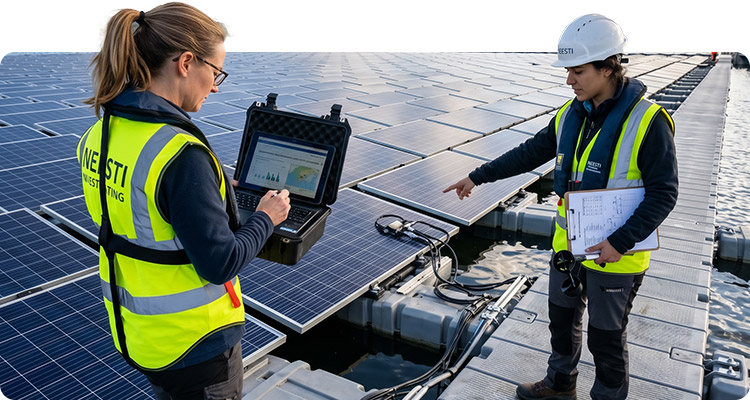
It isn’t testing whether floating solar works. That part’s been proven and tested. NEESTI is forming the AU-specific foundation for Australian farmland and agriculture. The frameworks, whether technical, economic, policy, or legal, that make it possible for an irrigator to approve and adopt the system on their own property.
The idea is to evaluate whether floating solar behaves differently depending on how each of the five sectors stores and uses irrigation water. (CRDC)
The research is looking at everything that would need to fall into place for irrigators to install it, from economics and approvals to insurance and grid access.
What To Do: Track NEESTI outputs through crdc.com.au and arena.gov.au. The project aims to make it easier for irrigators to assess whether floating solar is worth installing.
ARENA runs ongoing funding programs apart from NEESTI. The July 2025 announcement of AU$60 million for Ultra Low-Cost Solar PV R&D reveals long-term government investment in this area of solar. Set up funding alerts on arena.gov.au, so you stay up-to-date on application rounds.
Which Farm Operations Are Best Positioned Right Now
Floating solar isn’t one-size-fits-all. Not every irrigated farm is at the same stage. Research, funding frameworks, and regulatory pathways are tailored towards each of the five agricultural sectors.
Floating Solar Fit by Agricultural Sector:
The common thread across all five sectors? Large, existing water infrastructure that’s currently used as a single-purpose infrastructure.
Since FPV adds a second purpose to the same surface, there’s no need for land clearing. No need to build new infrastructure to avoid competing with the crop for space.
Note: Australia’s primary solar installation and safety standards (such as AS/NZS 5033) are legally required to align with international IEC (International Electrotechnical Commission) standards.
What To Do callout: If your property has 5 megalitres or more of on-farm water storage, it may be worth exploring whether floating solar could work there. The NEESTI project outputs will eventually provide a standardised framework, but preliminary assessments from FPV installers with agricultural experience are readily available.
As you plan to grow your team remotely, use the Remote Staff Free Outsourcing Calculator to punch in your numbers and see actual totals:
Who Runs the System After It’s Installed?
Once a floating solar system is commissioned on an agricultural dam, there’s more to manage besides the generation of energy: an ongoing layer of administration and compliance that keeps the system operational and economically worthwhile.
The talent is scarce in local market pools. So, Australian farm owners and irrigators are looking for specialists remotely.
Remote Staff has been pairing technical and operations professionals with Australian businesses for over 18 years. For agribusinesses and renewable energy operators moving into FPV, the roles most needed are platform-based, output-measurable. They don’t require physical site presence.
Grant and rebate administrators, energy project coordinators, compliance documentation specialists, data monitoring analysts, etc. All the roles you need for back office support, we vet for experience.
You’re accessing the same standard of professional work at a materially lower total cost because the talent is based in a different market.
Related Read: Here’s something about Agrisolar Hubs or Agrivoltaics Hubs, and Solar Farm Lease Guide Australia —how they, too, are changing Australia’s paddocks into power-generating sources of income.
FAQs
Can I put floating solar panels on my farm dam in Australia?
Yes, and the technology is being actively trialled across Australian irrigation dams right now. The NEESTI project is testing floating PV feasibility in cotton, sugarcane, grains, rice, and pecan sectors. Regulatory and technical frameworks for farm-level deployment are soon to be deployed.
How much water does floating solar actually save?
Research shows floating solar panels reduce evaporation from water surfaces by 25 to 70%, depending on the proportion of surface area covered and local climate conditions.
Does floating solar generate more power than ground-mounted solar?
Yes, in most conditions. The water underneath keeps panel temperatures 5 to 15°C cooler than equivalent land installations, which translates to 5–15% higher annual energy output. In Australia’s high-heat agricultural regions, the efficiency advantage is at the higher end of that range.
What is the 20% rule for solar?
It’s a sizing guideline that recommends designing a solar power system to produce 20% more energy than your household’s average usage. This intentional 120% target creates a crucial safety buffer to offset cloudy weather, natural efficiency drops in wires and inverters, and seasonal spikes in power consumption (like running summer air conditioning). It ensures that your home remains reliably powered year-round without running short.
What government funding is available for floating solar on Australian farms?
The NEESTI project, backed by AU$6 million from the Federal Government’s Future Drought Fund Resilient Landscapes program, is the primary current initiative. ARENA (Australian Renewable Energy Agency) also funds broader solar and agricultural technology programs. Monitor arena.gov.au and the Future Drought Fund portal for upcoming grant rounds targeting irrigator adoption.
Dams Are Losing Water. Will You Lose Your Source of Income, Too?
What is floating solar? Well, one thing’s for sure: there’s no going around what’s happening throughout farms and agricultural irrigation dams in Australia. The water’s getting depleted, and they’re not being replenished as fast, and as much, as they’re disappearing. It’s costing you money. And because it means less water for crops year after year, lower yields mean lower income as well.
The research backing, the government funding and support, and the testing and deployments are telling farmers and irrigators that the technology’s ready.
Save the dam, save your source of income, and the planet. Too idealistic? It’s more real now than it was a decade ago. All you have to do is make your irrigation dam available for a clean energy-generating system. As it happens, doing so even opens up a second and steady stream of income for you.
The farm dam has always been infrastructure. FPVs are just going to make it a productive one.
Ready to bring in remote specialists to your backend team? Call us or Request a Callback today.

Vaune Everis Cura has always been a writer in the truest sense, drawn to the art both as a personal creative pursuit and as a profession. Her experience penning content across digital marketing spaces and collaborating with business owners and market shapers has broadened her craft to include strategic direction and SEO insight. Having spent years with the InterContinental Hotels Group before stepping boldly into freelancing, she understands that at the centre of it all are genuine, meaningful brand–customer relationships built on purposeful, human content.