

In This Blog:
- ➤From Prime to Marginal: Solar Farm Lease Australia and How the Land Shift Came
- ➤Numbers That Land: How Much Is Land Worth to Lease in Australia?
- ➤When Guaranteed Income Replaces Yield Risk (What You’re Giving Up and What You’re Gaining)
- ➤The Contract Terms You’ll Live With For Decades
- ➤The Most Misunderstood Step: Option Agreement
- ➤Agrisolar: When the Back Paddock Becomes a Two-Income Asset
- ➤Remote Staff Section
- ➤FAQs
Rolling greens and cattle under clear blue skies. The rhythm of mustering sheep, as you wait for rain. Sounds almost romantic, doesn’t it?
Only, the reality of running a grazing property, especially marginal, low-performing country, is anything but.
And it’s because of rain. Or the unrelenting absence of it, from one dry season to the next.
Australia’s climate extremes mean seasons of low yield due to drought literally come with the territory. When harsh, dry cycles stretch on longer than the better ones, not even an excellent yield is enough to make up for the bad.
Not when you have a family to feed. Not when you have livestock and pasture to care for continuously.
Then you hear about a farm owner signing a solar farm lease agreement with developers. That’s stable income, no matter the weather.
Should you make the same move?
CSIRO’s 2026 research says that the land most likely to host solar is lower-profitability grazing country. It can represent reliable, drought-proof income.
Solar developers are ready to strike a deal. The question you need to ask is whether you understand the deal well enough to know what you’re agreeing to.
What is a solar land lease?
A solar land lease is a long-term commercial agreement where a landowner rents a portion of their property, frequently underutilized or lower-yielding grazing country, to a renewable energy developer in exchange for stable and predictable rental income. The developer installs, operates, and maintains utility-scale solar infrastructure on the site, typically committing to a timeline of 25 to 60 years. While the primary use of the designated acreage shifts toward clean energy production, strategic contractual frameworks like agrisolar can allow farmers to simultaneously run livestock, effectively transforming marginal country into a diversified, drought-proof asset.
From Prime to Marginal: Solar Farm Lease Australia and How the Land Shift Came
The appetite for prime agricultural land use for renewable energy development has cooled. Marginal grazing country is picking up steam.
CSIRO (Commonwealth Scientific and Industrial Research Organisation) research shows that using marginal country instead of prime agricultural land for solar infrastructure is better for Australia’s economy.
Turns out, the estimated loss to overall agricultural profit falls from around AU$29 million to AU$2.6 million. A reduction of roughly 90%.
Put simply, less prime productive land converted, less agricultural income displaced nationally. Smaller total loss for a solar land lease.
How Developers Found the Right Kind of Land
Developers define “suitable” land for solar infrastructure as:
Relatively flat or gently sloping. Has to be cleared, or previously cleared. Good proximity to transmission infrastructure. Good solar irradiance.
A perfect description of large parcels of land in the Australian grazing country, particularly lower-performing land in NSW’s Central-West, Queensland’s south-west, and inland Victoria. These are the same regions that belong to the list of potential REZs or Renewable Energy Zones. All hotbeds for renewable energy buildouts. (AEMO Integrated System Plan, 2026).
Is your marginal land within any of the corridors mentioned, according to solar farm companies looking for land? If it is, it just got renamed from “lower-yield pastoral country” to “strategic grid location.”
Worth Noting: low-yield land within these areas can claim higher negotiated leasing rates.
What To Do: Search ANU’s (Australia National University) renewable energy heatmap online and locate your property. If it’s in a high-solar-resource area close to transmission infrastructure, your property may already be on a developer’s shortlist. Whether you’re aware of it or not.
Related Read: Agrisolar and Regional Agrivoltaics Hubs are on the rise today. Discover more about the mechanisms behind them, and how industries are responding to the shift.
Numbers That Land: How Much Is Land Worth to Lease in Australia?
Standard solar farm leases are at AU$750–AU$1,500 per hectare per year (AUD$304 to $607 per acre per year). A 1,000-hectare lease at AU$1,000/ha equals AU$1 million per year (AUD$404.69 per acre per year). Every year. Regardless of rainfall. Small parcels can yield a profitable six-figure outcome: 20 hectares at AU$1,500/ha is a guaranteed AU$30,000 yearly. (CEC/Farmers for Climate Action report, 2025 to 2026)
Lease terms generally run for 25 to 30 years. Extensions bring that up to 40 to 60 years.
New Renewables Projects, New Numbers
Battery Storage Projects (5 MW BESS)
Landowners in QLD, NSW, and Victoria are being offered AU$30,000 per hectare per year for one hectare to host a 5 MW battery system. (Rok Solid AU renewable energy land brokerage report, August 2025). AU$900,000 over a 30-year term from a single hectare alone.
Wind Projects
Wind company payments are now above AU$40,000 per turbine per year. It’s a decent alternative, as some farmers who host dozens of turbines can continue to graze cattle or sheep around them.
Agrisolar and the Dual Income Potential
Agrisolar, or Agrivoltaics, allows income both from land leasing and continued grazing under panels. Similar to wind projects.
Real-life agrisolar examples:
Tom Warren, a NSW farmer near Dubbo, leased part of his property to a French solar developer. Tom now grazes 250 sheep under 64,000 panels. His land’s carrying capacity has increased nearly 25%. Wool quality is up due to reduced heat stress, and cleaner fleece (no burrs, less dust).
“
CEC estimates that between 2024 to 2050, farmers and landholders will receive AU$7.7–AU$9.7 billion in direct payments from renewables projects, mainly in land leasing or conversion.
Projected Australian Renewable Landholder Payments (2024 – 2050)
What To Do callout: Before making any decision on a developer’s offer, compare their numbers with others. Developers are in a race to close the most projects all over regional Australia. One tip? Don’t sign the first deal you come across.
When Guaranteed Solar Lease Income Replaces Yield Risk (What You’re Giving Up and What You’re Gaining)
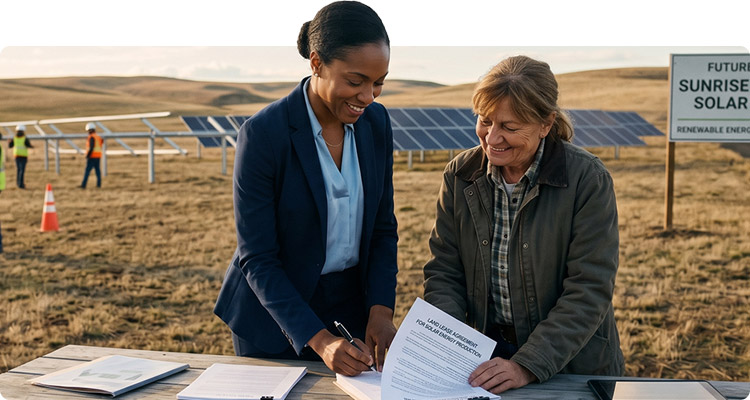
Leasing marginal land for solar development makes that parcel of land no longer viable for agricultural production. Throughout the term.
It can be difficult, parting with land you’ve relied on for agricultural livelihood for so long. But think of it this way: it’ll be committed to a different kind of use. Something that’s just as important not only to every Australian, but the planet:
Renewable energy production.
You’re also doing away with yield risks and red flags. No more depending on rainfall patterns for yield. No more carrying the uncertainty of season-to-season returns.
What The Exchange Implies
You remain the landowner. Only the use of your land changes. Often, within the scope of the developer’s operational requirements.
The reward is very promising: stable, contracted income. Predictable cashflow and passive income (and these are very good things). For utility-scale solar leases in Australia, payments are commonly structured annually, quarterly, monthly, or with option payments first.
Just note that you won’t feel that full income the moment you sign. Lease payments usually start once the project becomes operational, while use of the leased area may be restricted during construction.
The Contract Terms You’ll Live With For Decades
Here are some of the terms and long-term costs worth negotiating early, before signing. Changing them later may not be an option, especially once you start computing for farmland value.
When a Deal Looks Bad
Lease rates you agree to without independent advice? And quickly? You’re writing your way to a poor tradeoff. What seems an acceptable rate today can turn sour when factoring in inflation over time. That’s called the “inflation lock-in risk.” There’s no contractual provision or legal pathway to revisit or revise it.
Once you’re locked in, that’s it.
The protection against this is a rent escalator clause written into the contract from the very beginning. Typically linked to the CPI (Consumer Price Index), payments increase annually, in parallel with inflation. That way, it doesn’t stay flat throughout the contract’s lease term.
Decommissioning
As the lease comes to a close, the infrastructure should be removed and your land restored. Everything from panels to inverters, fencing, and access roads. They’re the developer’s responsibility.
If the contract says nothing about this obligation, or is ambiguous, the responsibility falls to you. Including the cost.
Taxes
Australia considers solar lease income as “assessable income.” The law treats it as taxable income. This means a change in land use can lead to a land tax reassessment. Something farmers don’t automatically account for when considering a lease.
Example: A farmer signed a 25 year lease. To his surprise, he received a significant property tax reassessment 18 months later. The farmer expected new lease income. What he didn’t expect:
Changing part of the property from agricultural use to commercial energy use could change how the property would be assessed for tax.
Work with a tax accountant and a rural property lawyer to avoid this complication. Income tax treatment and potential land tax implications should be laid bare before the contract is finalised.
What To Do: Do not make any decision on your first meeting with developers. Ask questions. Take notes. Don’t commit to anything. Not even if the developer asks you for some kind of verbal assurance. Make decisions only when your legal representative is around.
Related Read: Stay up-to-date with the looming Solar Panel Recycling Australia time bomb, and the opportunity you shouldn’t miss either.

The Most Misunderstood Step: Option Agreement
An option agreement comes before a solar land lease agreement. And it deserves just as much scrutiny as the main lease agreement.
What is an Option Agreement?
An option agreement gives a developer the exclusive right to lease your land at a future date, if the project moves ahead. In other words, not right now.
During the option period, the developer evaluates whether the project is viable. They do so through grid connection checks, environmental research, etc. Agreeing to this means that for this period, you get an option fee, not a part of the lease payments.
Call it compensation for reserving your land. If the findings show a low chance of success, the project won’t proceed. The developer leaves your land as is. You keep the option fee. If the project gets a green light and you sign, you still keep the fee. Win-win.
However, signing the option agreement means that, during the evaluation period, you won’t be able to:
- Lease the same land, or a part of it, to someone else
- Accept another solar proposal
- Sell freely without conditions
Depending on the clause, you can only decline or defer opportunities you encounter within the option agreement timeline.
The Option is More “Theirs” Than “Yours”
This agreement is designed to protect the developer. They have flexibility. You have less to none. Many landowners assume they can negotiate later, when really, many of the important terms may be locked in. Long-term.
The option agreement can feel preliminary to you, but parts of it may already function like the real negotiation. It may include terms such as:
- Rent escalator provisions (e.g. CPI-linked increases)
- Lease term and extension rights
- Land area covered by the lease
- Permitted uses of the land
- Access rights and access routes
- Exclusivity provisions
- Construction and development rights
- Decommissioning obligations
- Land restoration requirements
- Option period length and extension terms
- Termination rights and exit conditions
- Assignment or transfer rights
- Operational restrictions on surrounding land use
- Compensation arrangements
Many AU landowners aren’t aware of this agreement, and they sign without knowing the long-term implications.
This isn’t necessarily unfair. You can choose to sign or not sign, after all. It just means the time to ask questions and negotiate is before signing. The terms are usually locked in at the option stage and carried through to the final lease.
Worth noting: The developer may pay for your lawyer (up to a reasonable amount) to review the option agreement before you sign. One more reason for you not to skip an independent legal review.
What To Do: Have a rural property or renewable energy lawyer review the full document before you sign. Present all lease drafts attached. Exit conditions. Terms. Legal costs. Any clause about the rent escalator.
Having professionals go over the option agreement helps bring out obscure statements. They can also present scenarios and questions you haven’t thought of.
Agrisolar: When the Back Paddock Becomes a Two-Income Asset
Here’s where solar isn’t just. It’s agriculture activity plus solar production. On the same parcel of land. In our dedicated article about Agrisolar a.k.a. “Agrivoltaics Hubs” (LINK), we mentioned “sheep grazing under solar panels.”
It really does work.
Why Sheep, and Not Cattle?
It’s a size thing. Panels are spaced to allow sunlight and rainfall between rows. Sheep happen to comfortably fit in those rows. The panels then become useful to the flock, and even result in clearer fleece (less contamination from dust and burrs). They help improve pasture quality, too.
Tom Warren, one of Australia’s most cited early examples of agrisolar, saw land carrying capacity increase nearly 25% in the Dubbo Solar Hub. Other studies in different hubs report wool production up approximately 15%.
The Agrisolar Dual Income Structure
You receive an option fee, separate from lease payments. They need the grass managed. You need the grazing. It’s common in many agrisolar arrangements today.
Other Unforeseen Benefits
Overnight moisture collected on panels drains into the surrounding ground. A small contribution to drought-prone areas, but a massive help to solar leased farms.
What To Do callout: If your property grazes sheep and you’re thinking of considering a solar lease, ask if an agrisolar arrangement can be looked into. Something not all developers automatically include in a standard lease. Still, many aren’t averse to it. Some may even pay you a separate grazing management fee on top of the land lease rate.
Land Is Ready. So Is Solar. Now, You Need a Team.
Marginal land leasing in Australia has more people involved in agreements, disagreements, and negotiations than the developer and the farmer. You may need a rural property lawyer, a tax accountant, a valuer, a land agent or advisor, and planning and approvals specialists.
On some occasions, an agronomist or environmental consultant has a role to play as well, depending on the project.
These roles aren’t always readily available locally. In fact, with a demand spike in renewables, several roles are scarce in many areas. That’s why business and farm owners are turning to hiring offshore.
Remote Staff has been helping AU farmers and landowners get their back office set up for over 18 years. As you plan for leasing your grazing land, we vet the candidates you need for support, before and after you sign. Even after the project’s done, and you need a solid operational workforce, we’ve got your back.
The cost is friendlier than that of the local standard, only because the market location is elsewhere. The talent? The same high quality as anywhere else.
As you plan around refinancing or growing your business, learn How to Calculate Outsourcing Cost in Australia and hire for the right solar farm jobs.
And while you’re at it, be sure to stay compliant with this Payday Super 2026 Guide and the Modern Slavery Act Australia.
FAQs
How much do solar companies pay to lease farmland in Australia?
It’s generally AU$750–AU$1,500 per hectare per year range for solar, the AU$30,000/ha anomaly for small battery storage (5 MW BESS projects), and the AU$40,000+ per turbine for wind. Rates vary by location, proximity to transmission, project type, and your negotiation with the developer.
Can I still farm my land if I lease it to a solar developer?
Yes, with conditions. Agrisolar (sheep grazing under panels) and the dual-income model give you room to still farm land. Note that agrisolar arrangements are increasingly common and can be negotiated into the deal. With such an arrangement, the land is the developer’s alone to use.
What happens to my land at the end of the solar lease?
Decommissioning obligations take place. It’s important to have land restoration written into the contract. It should be clearly stated as the developer’s responsibility. If it isn’t, you shoulder both the obligation and the cost of doing so.
Is solar lease income taxable in Australia?
Yes. The income tax component often comes with the possibility of land tax reassessment on a change of use. Something many farmers aren’t aware of. Be sure to get tax advice before signing, rather than after.
In Marginal Land Leasing, The Margins Go Beyond What You Think
…as long as you review the agreement, negotiate terms, and ask questions before signing. All while you have legal representation guiding you through every step and lease draft.
For a parcel of land that’s idle, unused on the back of your property, it’s a meaningful income stream that also positively impacts the environment and the broader Australian economy.
You don’t need to be an expert in energy markets to make a good decision. You need the right advisers and the right questions. What you need is enough time to read what you’re signing.
Australia’s leap towards a renewable energy future is here. Catch it now before it slips past you.
When you’re ready to explore how to staff the administrative side of a long-term land lease, and beyond, Call us or Request a Callback. We’ll help you find the right person.

Vaune Everis Cura has always been a writer in the truest sense, drawn to the art both as a personal creative pursuit and as a profession. Her experience penning content across digital marketing spaces and collaborating with business owners and market shapers has broadened her craft to include strategic direction and SEO insight. Having spent years with the InterContinental Hotels Group before stepping boldly into freelancing, she understands that at the centre of it all are genuine, meaningful brand–customer relationships built on purposeful, human content.