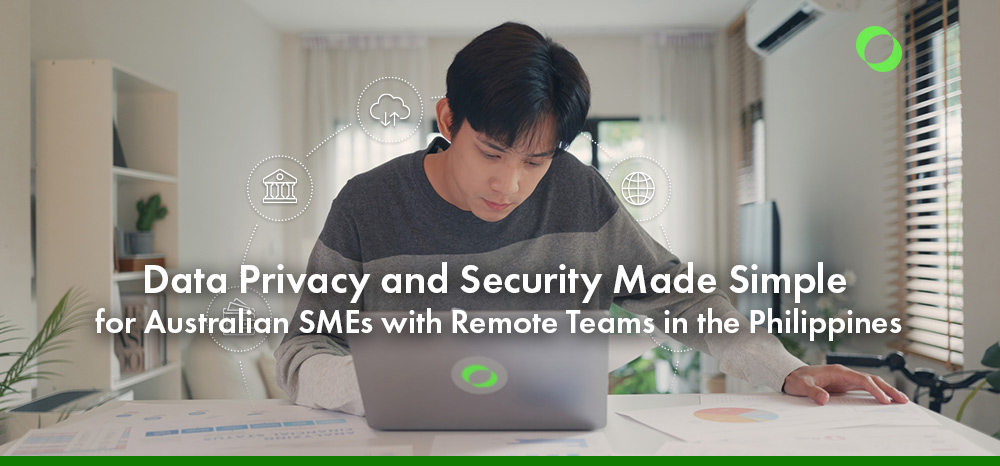
Remote work has transformed how Australian businesses operate and scale, but it has also expanded the attack surface for data breaches, compliance failures, and cybersecurity threats.
According to Harvard’s Privacy Office, remote environments significantly increase risks related to unauthorised access, unsecured networks, and poor device security, making strong security protocols essential for distributed teams.
Similarly, the London Governance & Compliance Agency (LGCA) notes that remote setups amplify vulnerabilities because organisations lose direct oversight of networks, devices, and user activity when teams work offshore.
This has direct implications for Australian SMEs outsourcing to the Philippines, especially those handling financial data, health information, customer records, or proprietary IP.
If you want to protect your business and your client’s privileged information, stay compliant with the Australian Privacy Principles (APPs), and confidently outsource to the Philippines under Data Privacy and Security best practices, keep reading!
Why Data Privacy Is Crucial When Outsourcing to the Philippines
As more Australian businesses rely on remote offshore teams, the value and sensitivity of the data exchanged daily has skyrocketed.
Data breaches now incur financial penalties, reputational damage, operation downtime, and long-term trust issues.
With cyberattacks rising globally, including phishing, ransomware, and identity theft, outsourcing without strong protections or protocols is no longer an option.
To outsource safely to the Philippines, leaders must understand the types of risk involved and the strict legal responsibilities tied to data governance.
Data Sensitivity in Remote Work
Industries like finance, healthcare, and SaaS manage high-risk information such as medical files, payment details, customer identities, and proprietary algorithms.
Remote workers accessing this data from home networks or personal devices increases exposure, making remote work cybersecurity essential.
Filipino remote teams must handle these datasets with strict secure remote access practices supported by encrypted communication tools and endpoint security solutions.
What Can Go Wrong Without Security Protocols?
Without structured cybersecurity measures, businesses expose themselves to threats that can quickly escalate into financial or legal crises.
Examples of risks include:
- IP theft, where unauthorized users copy or resell confidential or proprietary output
- Ransomware attacks exploit unsecured devices or networks
- Cloud storage misconfigurations are exposing confidential databases
- Password sharing, which weakens identity controls
- Unmonitored access enables harmful or accidental data changes
These risks underscore why offshore teams must use VPN for remote employees, enforce a password management policy, and follow proven cybersecurity best practices daily.
Overview of Philippine Data Privacy Laws (DPA 2012)
The Philippines enforces robust data governance through the Data Privacy Act of 2012 (DPA)—legislation designed to regulate personal information collection, storage, transfer, and access.
Australian companies outsourcing to the Philippines must understand how the DPA applies to offshore teams handling sensitive or regulated data.
The DPA is enforced by the National Privacy Commission (NPC), which has the authority to audit, penalise, and sanction private entities for violations.
Key Responsibilities for Foreign Employers
Regardless of location, foreign employers must meet specific obligations when Filipino remote staff handle personal or sensitive data to minimize their risk and exposure.
Key responsibilities include:
- Implementing organisational, physical, and technical safeguards for all stored or transmitted data
- Limiting access to only those whose job classification legitimately requires it
- Making sure of lawful data collection, retention, and deletion practices
- Protecting end-user privacy through encryption and secure storage
- Reporting breaches to the NPC when required
- Providing training on cybersecurity best practices for remote teams
These obligations apply whether the company has a local entity or hires through compliant outsourcing partners like Business Process Outsourcing (BPO) entities) or Employers of Record (EoR).
Comparison to Australian Privacy Principles (APPs)
Let’s take a look at the similarities and distinctions between the Philippines’ DPA Laws and Australia’s 13 Australian Privacy Principles (APPs) under the Privacy Act:
Key similarities include:
- APP 1 & DPA: Accountability & Governance — Both require internal policies, documentation, and safeguards.
- APP 6 & DPA: Use and Disclosure — Personal information must only be accessed for authorised purposes.
- APP 11 & DPA: Security of Personal Information — Organisations must protect data using reasonable technical measures.
- APP 12 & DPA: Access and Correction — Individuals can request access to or correction of their data.
High-Level Comparison Table
Requirement | Australian APPs | Philippines DPA 2012 |
Governance | High | High |
Consent Requirements | Strong | Strong |
Security Measures | Mandatory | Mandatory |
Breach Notification | Required | Required |
Cross-Border Controls | Strict | Strict |
Filipino remote workers are also governed by a similar set of data privacy laws, which can give SMEs some peace of mind that outsourced teams must also adhere to a set of data security standards.
Common Security Risks When Managing Offshore Teams
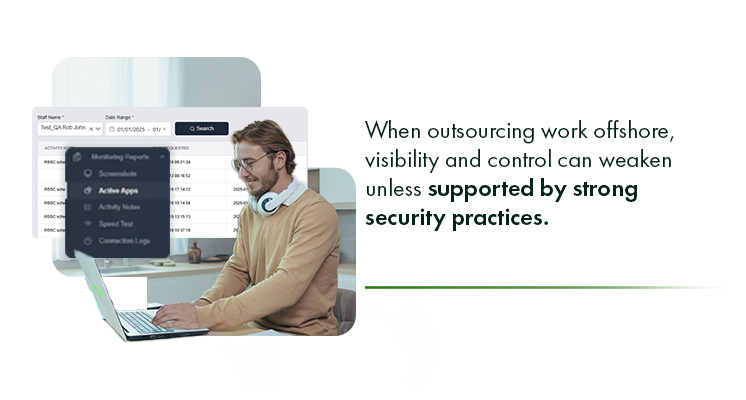
When outsourcing work offshore, visibility and control can weaken unless supported by strong security practices.
Many breaches happen not because of malicious intent, but because systems were unsecured or mismanaged.
To cultivate a secure remote workforce, businesses must recognise common failure points and proactively prevent them.
Unauthorized Access and Account Sharing
Unauthorised access often occurs when remote workers share credentials, use weak passwords, or access sensitive files on unsecured devices.
Without Zero Trust security models or multi-factor authentication (MFA) enforcement, it becomes difficult to verify who is accessing what, increasing exposure to insider threats or accidental misuse.
Insecure Communication Channels
Remote teams that rely on unencrypted messaging apps or public Wi-Fi expose data to interception.
Without encrypted communication tools or a VPN for remote employees, messages, files, and login credentials can be easily compromised by cybercriminals monitoring unsecured traffic.
Lack of Device or Network Monitoring
Many offshore setups lack endpoint security solutions or device monitoring, leaving employers blind to risky behaviour such as unauthorised downloads, external drive usage, or access attempts at unusual hours.
Without monitoring tools, it’s impossible to enforce data privacy and security consistently.
How Remote Staff Protects Your Data and IP
Remote Staff goes beyond standard outsourcing by embedding proactive, always-on security systems designed for distributed Philippine teams.
Unlike unmanaged freelancers or generic global EORs, Remote Staff integrates technology, compliance, and HR oversight to give Australian SMEs continuous visibility and full legal protection.
Encrypted Monitoring & Screen Capture Tools
Remote Staff uses encrypted remote desktop security tools and DIWA monitoring software to help employers maintain compliance without invading privacy.
These tools track productive hours, detect anomalies, and capture screens for accountability and to help prevent the misuse of sensitive information.
Role-Based Access & Device Controls
Role-based access guarantees that employees only view the information required for their duties. This aligns with secure remote access principles and the Zero Trust security model.
Device requirements such as antivirus, patch updates, and VPN use help maintain consistent cybersecurity hygiene as well.
Legal Protections (NDAs, CoR Contracts, Audit Trails)
Every engagement includes NDAs, Contractor-on-Record agreements, and audit trails to protect confidential information and intellectual property.
These legal protections reduce misclassification risks and secure the employment relationship with clear boundaries, benefits, and responsibilities.
SOPs for Securing Data Privacy When Outsourcing to the Philippines
Strong data security is not a one-time setup—it requires structured onboarding and ongoing compliance.
The following SOPs help Australian SMEs build safe, predictable systems when working with Filipino remote teams:
During Onboarding: Secure Setup Essentials
Before work begins, businesses must guarantee their teams use protected systems and proper authentication.
Best practices include:
- Secure workstation configuration with endpoint security solutions
- Enforced MFA
- VPN setup for remote employees
- Password management policy using encrypted vaults
- Restrictions on BYOD (bring your own device) through approved BYOD security protocols
- Cloud access segmentation by job classification
Ongoing: Monitoring, Auditing, and Legal Coverage
Long-term security requires continuous oversight, especially for remote workers handling sensitive data.
Ongoing protections include:
- Encrypted monitoring systems for secure visibility
- Quarterly cybersecurity audits
- Regular employee training on phishing and identity threats
- Legal documentation updates (NDAs, access rights, termination procedures)
- Audit logs documenting access, downloads, or policy violations
- Encryption for all stored or transmitted work data
Remote Staff vs Generic Freelancers and BPOs
Choosing offshore talent is no longer just about cost savings—it’s about data privacy and security, legal compliance, and predictable outcomes.
Australian businesses that rely on inexperienced freelancers or low-cost BPO vendors often face visibility gaps, vague accountability, and weak remote work cybersecurity standards.
Remote Staff greatly mitigates (if not outright eliminates) these risks with structured oversight, secure remote access tools, and a compliance-first hiring ecosystem built for long-term stability.
Transparent Monitoring vs Unverified Workflows
Many freelancers work without monitoring or supervision, so businesses may not be able to check how their data is accessed, stored, or shared.
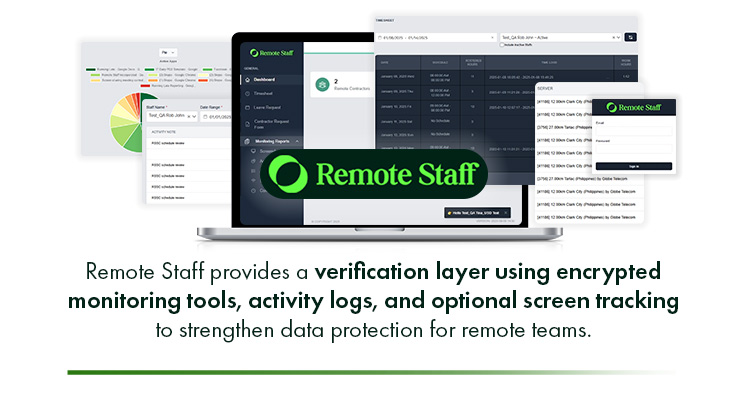
Remote Staff provides a verification layer using encrypted monitoring tools, activity logs, and optional screen tracking to strengthen data protection for remote teams.
This transparency supports stronger cybersecurity best practices and reduces exposure to unrecorded workflows or unsafe devices.
Legal Accountability vs Risky Informal Contracts
Freelancer agreements rarely meet the standards required for secure compliance for remote work, especially when handling sensitive information.
In contrast, Remote Staff uses formal Contractor-on-Record and EOR-backed agreements that incorporate NDAs, intellectual property protection, and strict adherence to Philippine and Australian privacy standards.
This protects businesses from misclassification risks and shields them from legal vulnerabilities tied to informal contractor setups.
Scalable and Secure Hiring at Every Stage
While BPOs may lock companies into rigid roles and long-term contracts, Remote Staff enables secure scaling across admin, finance, IT, marketing, and specialist roles.
Each hire operates with secure remote access policies, MFA, endpoint security solutions, and clear data handling SOPs.
Whether you need one worker or an entire team, you get a scalable system anchored in remote desktop security and Zero Trust security model principles.
Frequently Asked Questions (FAQ)
Hiring offshore talent raises understandable questions about data privacy and operational safety. Here are the concerns Australian SMEs bring up most often.
Is it safe to outsource sensitive data to the Philippines?
Yes. As long as you work with providers that follow the Philippine Data Privacy Act (DPA 2012), apply strict access controls, and implement cybersecurity best practices such as MFA, VPN for remote employees, and encrypted communication tools.
Does outsourcing sensitive data to the Philippines violate Australian privacy laws?
No. Cross-border processing is allowed under the Australian Privacy Principles (APPs) as long as the offshore provider provides the equivalent of required protections and the business establishes proper data handling agreements.
How do I protect client data with offshore staff?
Use secure remote access systems, enforce a password management policy, apply device restrictions or BYOD security protocols, and make sure staff operate under structured privacy SOPs paired with monitoring and audit trails.
What’s the difference between Remote Staff and a BPO for security?
BPOs centralise work but often limit visibility—Remote Staff provides individual hires with end-to-end compliance, activity monitoring, and role-based security controls, giving clients full oversight of their remote workforce.
Can I monitor remote staff without violating privacy?
Yes. Monitoring is allowed when workers provide consent, data is encrypted, and tools are designed for productivity tracking rather than personal surveillance, all of which Remote Staff incorporates into its processes.
Ready to Hire Securely and Stay Compliant?
Modern remote hiring requires data privacy and security, airtight compliance, and strong cybersecurity frameworks that protect your business across borders.
If you’re scaling a remote team, make sure you’re doing it with the right safeguards, policies, and partners in place.
Request a call back to explore our privacy framework and see how Remote Staff keeps Australian businesses protected while giving them access to top-tier Filipino talent!
- Want FREE AI Prompts for Different Areas of Your Business? Check out these 100 AI prompts.
- Curious About How to REDUCE Overhead Costs? Learn more here.
- If you’re ready to experience the full advantages of working with a top global team, check out our 1,000 fully vetted and highly talented staff here.

Darren Aragon is a multifaceted writer with a background in Information Technology, beginning his career in research at Pen Qatar and transitioning through customer service to a significant role at Absolute Service, Inc. His journey into freelance writing in 2021 has seen him excel across various niches, showcasing his adaptability and deep understanding of audience engagement.