
Hiring in the Philippines has never been more attractive for Australian SMEs.
With rich talent pools, strong English proficiency, and a mature remote work culture, Filipino teams power thousands of Australian businesses across industries like e-commerce, SaaS, healthcare, engineering, logistics, and financial services.
But here’s the part many business owners don’t hear upfront: it’s no longer as easy to hire a Filipino worker without navigating Philippine labour laws, tax requirements, and classification rules. And regulators are tightening oversight.
According to L&E Global (2024), foreign companies hiring Filipino workers without proper structures may still be held liable under Philippine labour standards – even without a physical presence in the country.
Remote work may feel borderless, but employment law is not.
If you want to build a Filipino workforce without incorporating locally, you’ll need a compliant hiring strategy that keeps operations smooth and risks low.
The insights ahead show you exactly how smart and successful Australian businesses do it WITHOUT shortcuts, confusion, and ending up on the wrong side of Philippine regulations.
Can You Hire in the Philippines Without Setting Up a Company?
Yes—foreign companies can hire employees in the Philippines, but only if you follow lawful engagement models.
Hiring directly without an entity is legal only in very specific scenarios, and missteps can lead to misclassification, tax liabilities, or labour disputes.
Before diving into solutions, it’s important to clear up the myths.
Common Misconceptions About Overseas Hiring
Many Australian SMEs begin with assumptions like:
- “If they’re remote hires, Philippine labour laws don’t apply.”
- “Contractors are always the safest option.”
- “I don’t need to worry about benefits if they’re offshore.”
- “Hiring on freelancing platforms = compliant hiring.”
These assumptions are wrong. Philippine law protects remote employees under the Telecommuting Act (RA 11165), which mandates equal rights and benefits for remote workers.
Philippines Remote Workforce Legal Requirements
Even without a Philippine entity, certain obligations still exist:
- Philippine labour standards may apply depending on the employment arrangement
- Income tax and withholding rules must be honoured
- Mandatory benefits (SSS, PhilHealth, Pag-IBIG) may be required
- Contracts must follow Philippine labour guidelines
- Termination rules must comply with local regulations
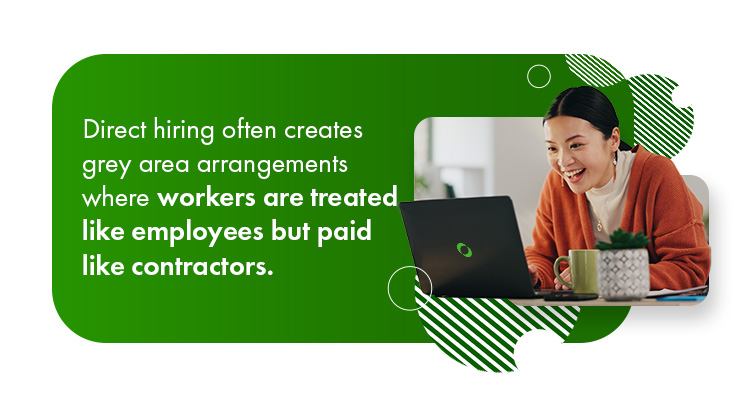
Direct hiring often creates grey area arrangements where workers are treated like employees but paid like contractors. This leads to:
- misclassification disputes
- tax compliance failures
- underpayment of benefits
- costly labour claims
- unintentional creation of a permanent establishment
It’s legal to employ Filipino workers abroad, but only if done through recognised, compliant structures.
What Are Your Options for Hiring in the Philippines Without an Entity?
Australian SMEs essentially have three paths. Each comes with different compliance obligations, cost structures, and risks.
Contractor vs. Employee: What’s the Difference?
Engaging Filipino talent as a contractor may work for some roles, but only if the working relationship fits.
In the Philippines, contractors must:
- control their own time
- provide their own tools
- work for multiple clients
- operate independently
If the worker follows your schedule, uses your systems, and works exclusively for you, regulators may classify them as an employee even if their contract says otherwise.
Misclassification is one of the biggest compliance red flags.
Third-Party BPO vs. Employer of Record
A BPO hires workers and assigns them to you, but you lose control over recruitment, culture, systems, and workflows. It’s great for customer service, but restrictive for specialised roles.
An Employer of Record (EOR) legally employs Filipino workers on your behalf, giving you full operational control while the EOR manages payroll, benefits, HR, and compliance
EORs eliminate nearly all offshore compliance risks without requiring you to set up a company.
Pros and Cons of Each Hiring Option
Contractor, BPO, or Employer of Record (EOR), each of these options has benefits—and serious limitations—depending on what the business needs.
Here’s a more detailed, business-owner-friendly breakdown to help guide strategic decisions.
Contractor Model
Hiring Filipinos as independent contractors is usually the first instinct for SMEs because it feels simple and flexible. But it’s also the option with the highest compliance risk.
Pros
- Flexible engagement. Perfect for short-term tasks, project-based work, or test hires.
- Fast onboarding. You can engage a contractor in hours with minimal paperwork.
Cons
- High misclassification risk. If the contractor works full-time hours, uses your tools, follows your schedule, or receives ongoing supervision, Philippine authorities may consider them an employee, not a freelancer. This can expose Australian businesses to wage claims, benefits liabilities, and tax issues.
- No structured benefits. Contractors do not receive SSS, PhilHealth, Pag-IBIG, or paid leave. This impacts retention and can create future disputes.
- Challenging for long-term retention. Skilled contractors often juggle multiple clients. If they get a better offer, turnover is high.
Best for: Short-term or one-off tasks.
Not ideal for: Permanent roles, recurring work, or roles requiring daily oversight.
BPO (Business Process Outsourcing) Model
BPOs hire the staff on your behalf but assign them to your company.
This structure suits call centres and large-volume teams, but it’s less flexible for specialised roles or companies wanting direct relationships with their staff.
Pros
- Easy to deploy large teams. BPOs specialise in customer support, data entry, and similar repeatable roles.
- Good for bulk hiring. If you need 20 customer service reps tomorrow, a BPO can deliver.
Cons
- Less control over hiring. The BPO decides who to hire. You typically cannot handpick the talent on your team or customise job roles much further.
- Higher cost markup. You pay a premium because BPOs charge operational markups (overheads, management fees, facility costs). In some cases, only a small portion of what you pay reaches the worker.
Best for: Large teams, customer service, or heavily systemised tasks.
Not ideal for: Startups, SMEs needing niche talent, or businesses wanting full control of their remote staff.
Employer of Record (EOR) Model
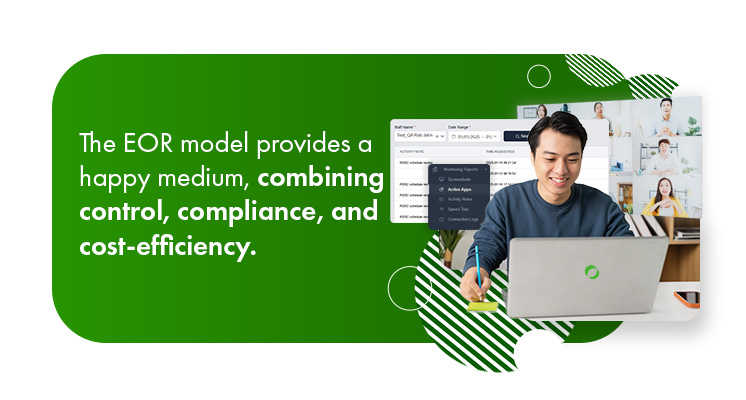
The EOR model provides a happy medium, combining control, compliance, and cost-efficiency.
The EOR becomes the legal employer, while you retain control over day-to-day management. This allows you to hire in the Philippines without setting up an entity and without the restrictions that come with a BPO.
Pros
- Full compliance. The EOR manages local labour laws, contracts, benefits, and statutory contributions, safeguarding you from misclassification and local labour disputes.
- You choose and manage your talent. Unlike a BPO, you pick your staff directly, supervise them, integrate them into your workflows, and build long-term relationships.
- Payroll + benefits handled for you. The EOR processes payroll, remits taxes, pays SSS/PhilHealth/Pag-IBIG, and handles leaves, HR matters, and documentation.
Cons
- Not ideal for physical office setups. If you want to operate a full Philippine office, incorporating locally may eventually be more appropriate.
Best for: SMEs hiring 1 to 20 remote staff, long-term roles, skilled positions, compliance-conscious businesses.
Not ideal for: Companies needing a physical Philippine branch or on-site workers.
What Is an EOR in the Philippines?
An EOR is a local organisation that legally employs your Filipino talent on your behalf. You retain full operational control, while the EOR handles compliance, payroll, contracts, benefits, and HR.
Think of it as global hiring Philippines – no entity needed.
How EOR Works for Foreign Employers
EORs handle:
- Employment contracts aligned with Philippine labour laws
- Payroll processing and mandatory tax withholdings
- SSS, PhilHealth, and Pag-IBIG contributions
- Timekeeping and attendance monitoring
- Government reporting and HR compliance
- Local employee protections
Benefits of EOR: Compliance, Payroll, HR, Legal Protection
EORs remove the risk of misclassification and regulatory oversight by managing:
- Philippines payroll compliance for foreign companies
- Remote workforce Philippines employment law requirements
- Local employee benefits and mandatory contributions
- Termination procedures aligned with the Philippine Labour Code
- Legal risk in case of disputes
This guarantees you can hire remote Philippines staff legally and confidently.
How Remote Staff Simplifies the EOR Experience
Remote Staff has operated in the Philippines for 17+ years, supporting thousands of Australian SMEs with compliant offshore staffing.
They provide:
- End-to-end Philippines employer of record services
- Pre-vetted Filipino talent across 150+ roles
- Payroll, HR, and compliance handling
- Local labour law expertise
- Termination and dispute management
- Real-time productivity tools
- Transparent pricing — no hidden markups
EOR offers fast hiring, legal certainty, and stable operations. It lets you test and leverage the Philippine talent market without committing to formal incorporation onsite.
Key Compliance Considerations When Hiring Without an Entity
Foreign businesses hiring in the Philippines must understand that local labour and tax rules may still apply, even without a physical presence.
If a Filipino worker operates like an employee: with fixed hours, ongoing duties, and access to your systems, authorities may classify them as one and consider them qualified for tax withholding, SSS/PhilHealth/Pag-IBIG contributions, and proper termination procedures.
Knowing these requirements helps Australian SMEs avoid misclassification, reduce legal risk, and build a compliant remote workforce.
DOLE Registration, BIR Withholding, and SSS/PhilHealth Requirements
Local compliance includes:
- DOLE records and labour reporting
- BIR tax withholding and monthly filings
- Mandatory SSS, PhilHealth, and Pag-IBIG contributions
- Proper computation of holiday pay, overtime, and 13th-month pay
How EOR Eliminates Local Registration Headaches
An EOR manages:
- registering workers with government agencies
- ensuring required contributions are paid
- preparing compliant payslips
- managing tax reporting
- handling contract renewals and exits
Basically, an EOR circumvents the need to register for a legal entity.
What You’re Still Responsible For as an Employer
You still call the shots for:
- day-to-day tasks and performance
- workload, KPIs, and training
- culture, communication, and team integration
- quality control and deliverables
The EOR handles all legal and compliance matters, while you simply manage the team.
Understanding Philippine labour law reduces perceived risk, builds trust, and prevents costly non-compliance errors.
When to Use an EOR in the Philippines
EOR is ideal for organisations that need speed, compliance, and flexibility when hiring in the Philippines. It allows Australian SMEs to build a remote team quickly without navigating the intricacies of a local entity setup, payroll rules, or labour regulations.
Instead of juggling contracts, taxes, and government filings, an EOR handles the legal and administrative backbone while you stay focused on performance, training, and growth.
This model gives businesses the freedom to scale up or down, test new roles, or enter new markets confidently—all while avoiding the misclassification and compliance risks that come with direct or contractor-based hiring.
Hiring 1 to 20 Staff Quickly
For many Australian SMEs, the real advantage of using an EOR is the operational stability it creates behind the scenes.
Instead of juggling shifting labour rules, inconsistent contractor arrangements, or unfamiliar government processes, businesses gain a structured framework where employment, payroll, benefits, and HR administration are handled with precision from day one.
This removes the bottlenecks that typically slow down offshore hiring, such as drafting compliant contracts, calculating statutory contributions, or resolving disputes.
It also gives companies a smoother path to building long-term, high-performing teams.
With less time spent troubleshooting admin issues, leaders can concentrate on integrating talent, strengthening culture, and driving projects forward.
Exploring New Markets Before Committing
Using an EOR makes it easy for Australian businesses to explore new markets because it removes the pressure to commit long-term before you’re ready.
Instead of investing in incorporation, legal counsel, and local compliance systems, you can build a small team, run pilot projects, and validate whether the Philippine talent ecosystem supports your operational goals.
This approach gives you real-time performance data: how fast work gets delivered, how well communication flows, and how effectively roles scale without locking your business into costly structural decisions.
It’s a low-risk, high-learning model that lets you fine-tune your offshore strategy based on evidence, not guesswork.
Converting Contractors to Compliant Employees
Many Australian SMEs convert contractors to EOR-employed staff to avoid:
- misclassification risk
- incorrect tax treatment
- benefit disputes
- unstable retention
How Remote Staff Helps You Hire in the Philippines
Hiring in the Philippines without a local entity becomes dramatically simpler when you work with a partner that already has the infrastructure, legal presence, and operational maturity on the ground.
Remote Staff has been supporting Australian businesses long before “borderless work” became a buzzword, giving SMEs a compliant, low-risk pathway to employ Filipino workers abroad without having to navigate the heavy regulations alone.
With local HR teams, payroll specialists, and deep expertise in Philippine labour law for foreign employers, Remote Staff bridges the gap between global hiring and full compliance for each valued client.
17+ Years of Experience with AU & US Businesses
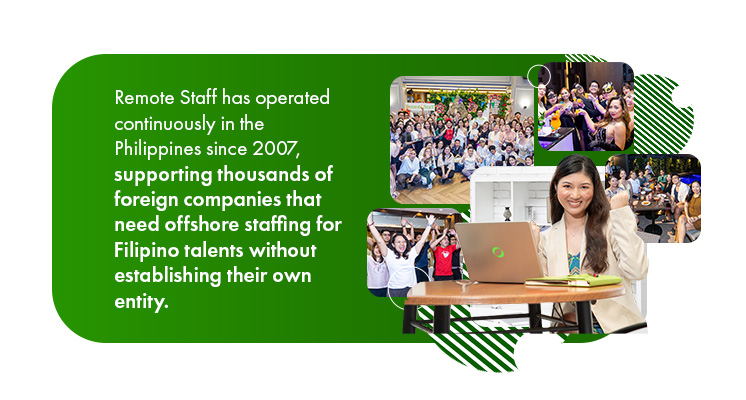
Remote Staff has operated continuously in the Philippines since 2007, supporting thousands of foreign companies that need offshore staffing for Filipino talents without establishing their own entity.
Over this period, the company has become a trusted partner for Australian and US SMEs that want to scale quickly while staying compliant with the Philippines remote workforce legal requirements.
Remote Staff’s long-term presence means it understands both the cultural nuances of Filipino professionals and the regulatory obligations facing foreign employers.
This experience allows businesses to grow confidently, knowing they’re backed by a team that has mastered EOR Philippines hiring for foreign companies long before the model became mainstream.
Legal Infrastructure, Local HR, and Payroll Teams
Remote Staff provides the full Philippine infrastructure required to support a compliant remote workforce:
- Local HR compliance experts who manage contracts, onboarding, and employee relations
- Philippines payroll compliance for foreign companies, including tax withholding, SSS, PhilHealth, and Pag-IBIG
- Labour law guidance for foreign companies that need clarity on benefits, leave, and termination rules
- Real-time attendance and productivity monitoring tools
- Dedicated account managers aligned with AU business hours
This infrastructure allows you to leverage international recruitment in the Philippines with no setup cost or a lengthy entity formation process—a complete solution that lets you employ Filipino workers abroad safely and legally.
Hybrid Models
Remote Staff recognises that business needs vary, so it provides flexible hiring models beyond standard Philippines employer of record services:
- Employer of Record (EOR) for full employees with complete benefits compliance
- Contractor-on-Record for legally managed freelancers with optional HR support
- Mixed teams for different departments (e.g., EOR for long-term staff, contractors for short projects)
- Fast transitions from contractor status to full EOR employment to avoid misclassification risks
These hybrid structures give businesses the freedom to scale while staying aligned with the remote workforce Philippines employment law.
Frequently Asked Questions (FAQ)
Hiring overseas can feel intimidating when you’re navigating it for the first time.
Below are the most common questions Australian businesses ask when they want to hire Philippines without local entity requirements or legal worries.
Can I legally hire someone in the Philippines without a company?
Yes. Foreign companies can hire employees in the Philippines through a compliant structure such as an Employer of Record (EOR).
This allows you to employ Filipino workers abroad without registering a Philippine entity.
Do I need to pay Philippine taxes as a foreign business?
Not directly. However, Filipino employees require tax withholding, mandatory contributions, and payroll compliance, which an EOR handles on your behalf to keep everything legal.
What’s the fastest way to start employing from the Philippines?
Using EOR services is the fastest method. You can onboard staff within days because the legal infrastructure already exists.
No registration, no setup, and no waiting months for government approvals.
Is hiring a freelancer the same as hiring an employee?
No. Freelancers are not covered by mandatory benefits and follow different labour rules.
Treating a freelancer like an employee can trigger hire Philippines contractors vs employees misclassification penalties. An EOR prevents this very issue.
What is the cost of using an EOR?
Costs vary based on role, seniority, and workload, but EOR pricing is generally far lower than establishing a local entity.
You pay a transparent monthly fee that covers benefits, payroll, HR, and compliance. No hidden costs or government surprises.

Ready to Hire Remotely in the Philippines?
Building a compliant, high-performing Filipino team doesn’t require opening a company in the Philippines—just the right partner.
With Remote Staff’s long-standing expertise, legal infrastructure, and proven EOR Philippines hiring solutions, Australian businesses can hire quickly, reduce risk, and scale confidently.
Take the safer, smarter path to global hiring in the Philippines—with no entity required, no compliance headaches, and no uncertainty getting in the way of your company’s progress.
Request a call back now!
- Want FREE AI Prompts for Different Areas of Your Business? Check out these 100 AI prompts.
- Curious About How to REDUCE Overhead Costs? Learn more here.
- If you’re ready to experience the full advantages of working with a top global team, check out our 1,000 fully vetted and highly talented staff here.

Darren Aragon is a multifaceted writer with a background in Information Technology, beginning his career in research at Pen Qatar and transitioning through customer service to a significant role at Absolute Service, Inc. His journey into freelance writing in 2021 has seen him excel across various niches, showcasing his adaptability and deep understanding of audience engagement.