What is a data entry specialist?
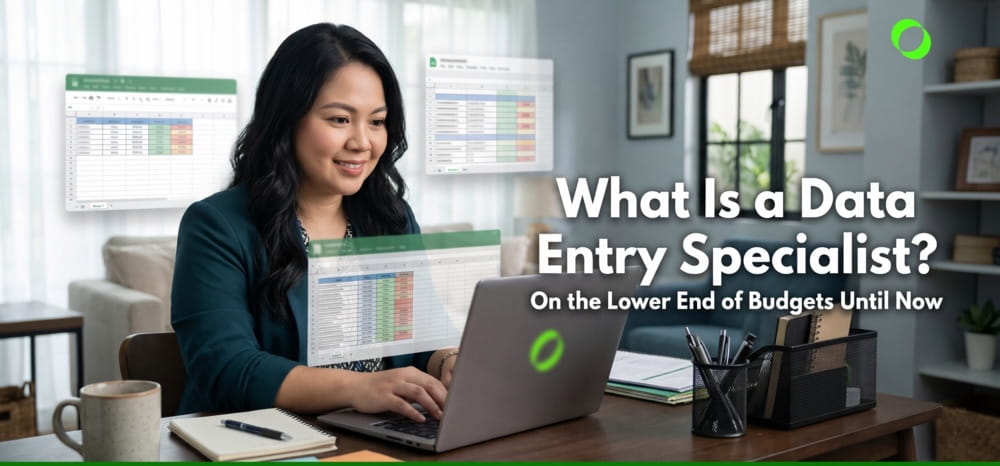
A data entry specialist is responsible for entering information into a business’s digital systems and checking that it matches the original source. They maintain records in spreadsheets, databases or business software, depending on the employer’s needs. The role requires careful attention to detail, since incorrect information can affect other teams’ work. Accurate records help businesses keep their operations organised and make decisions using reliable information.
Spreadsheets upon spreadsheets upon spreadsheets. Shall we add another “spreadsheet” to that? For emphasis?
Tab after tab, sheet after sheet, it’s a daily task. A tedious chore to others. Sometimes, you feel there are too many of them, and so just as many are relegated to the back of your team’s minds.
You tell yourselves which ones don’t belong to this side of reality. Not today.
Spreadsheets belong to the foundations that prop up documentation and order. And yet they go to a team member who’s got extra time (usually outside work hours) because answering “What is a data entry specialist?” doesn’t hold much water to warrant any mention in hiring plans.
The assumption is it’s the least skilled role in your workforce.
Is it?
Because businesses in Australia are increasingly hiring remote data entry specialists. Here’s why, and what you should know about the role.
In This Blog:
- ➤What is a data entry specialist?
- ➤What Does a Data Entry Specialist Do?
- ➤What Are Some Common Tools Used For Data Entry?
- ➤Who Do Data Entry Workers Work With?
- ➤What Is The Difference Between Data Entry Specialist vs Data Entry Clerk?
- ➤What Skills Are Needed For a Data Entry Job?
- ➤Can A Data Entry Specialist Work Remotely?
- ➤What Is the Average Data Entry Specialist Salary in Australia?
- ➤Four Signs It’s Time To Hire a Data Entry Specialist
- ➤What Tasks to Assign a Data Entry Specialist in the First Month?
- ➤Unsure How to Hire a Remote Data Entry Specialist?
- ➤FAQs About Outsourcing a Data Entry Specialist
- ➤Clean Records Start With the Right Professional Assigned to Them
What Does a Data Entry Specialist Do?
A data entry specialist moves – or “enters” – information from its original sources to the systems your business runs on. The latter are often paper forms, PDFs, scanned receipts, web orders, email attachments, even handwritten notes from sales reps to customer support, inventory sheets, CRM, and accounting software.
Typing’s the main part of the role. But checking, having eyes that scan through each detail and being able to isolate errors, is another crucial and valuable chunk. A larger chunk, if we may say so.
New entries are compared against what’s stored, and the specialist catches the transposed digit or the postcode that isn’t matching anything. You know, the ones lacking another digit or two, or have a digit or two too many.
Or names and entities that are misspelled. Or duplicates.
Anything off is triple-checked before it goes in.
What Are the Daily Tasks of a Data Entry Specialist?
When answering “what do data entry specialists do,” we want to point out that the industry will add to or replace anything in the above.
A couple of examples:
The data entry virtual assistant in a medical office works with billing codes and insurance details.
In online retail, the data keyer goes on to reconcile product listings against stock counts.
A construction firm needs timesheets and subcontractor invoices logged.
What Are Some Common Tools Used For Data Entry?
What tools do data entry specialists use:
What about automation?
Automation certainly does some of the typing today. OCR and robotic process automation read clean, consistent documents quickly.
However, input that’s very much human, from a handwritten form to an invoice from a new supplier where the layout often changes, belongs to the data entry VA.
At the same time, whatever the software automates and churns out, the specialist still needs to review and check for quality assurance and accuracy.
Who Do Data Entry Workers Work With?

Since most types of records touch every department, most specialists are on the radar of several colleagues’ collab lists every week. And from different departments at that.
Finance and Accounting
Invoices and payment details pass through the specialist on their way to the accounting software. The bookkeeper or accountant is usually the first to flag a mismatch at month-end.
Sales
Sales sends over new leads, business cards, and order forms, and expects contact records that are complete and easy to find. Reps unable to locate a customer’s last order? They’ll be asking the data entry specialist.
Warehouse and Operations
These teams send stock counts and shipping updates that need to be entered or updated in the relevant systems.
Customer Service
Customer service passes on wrong addresses and duplicate accounts as they come up, making the team a steady source of corrections.
Marketing
Marketing wants the cleanest version of the contact list, because a single duplicate means one customer gets the same email twice (it also then becomes Sales’ problem, when leads and customer lists aren’t reliable).
IT
IT gets involved with permissions and backups.
Managers and Business Owners
Most data entry operators report to a manager, supervisor, team leader, or business owner. Three or four of them may, in a business with fewer than ten people, send most of the requests, so the specialist ends up working them simultaneously.
What Is The Difference Between Data Entry Specialist vs Data Entry Clerk?
Have you tried typing in “data entry specialists” on job boards? The algorithm may not pick up the right rates, especially because Australian listings add “data entry operator” and “data entry officer” to the same title.
What separates the roles is how much each one decides for themselves.
A clerk covers you if your records already follow a clear standard and you just need volume. If no standard exists yet, you want the specialist, since somebody has to write the rules before anyone can follow them.
A huge note on this: Although there are distinctions to the roles, they’re generally used interchangeably, along with “data entry operator.” You’ll have to know what tasks you need related to data entry and differentiate what specialization your business needs.
What Skills Are Needed For a Data Entry Job?
Typing Speed. You’d think this wouldn’t be as essential a skill, but it is. That’s why job posts always have this among what they require under “qualifications.”
So test candidates on it. It’s not so much the typing speed in itself, but speed both in keying data AND in correcting data. Hence, the importance of typing proficiency.
What To Do: The better test is a short paid sample built from a slice of your own messy records, scored on accuracy first and time second.
Spreadsheet Skills, along with typing speed, make for the perfect pair. Strong specialists can sort and filter a large sheet without throwing cells and rows and columns into spin, setting validation rules so a date field refuses text. All while maintaining their (and your team’s) sanity, in exchanges. Plus staying consistent in this type of work, day after day.
After that comes comfort with your database or CRM, and sensible habits around sensitive records such as payment details and employee files.
Soft skills are also vital. Repetitive work needs patience and a steady routine (calling back to what we mentioned about consistency).
Specialists who are a step ahead of the rest proactively question a record that looks odd and write a short, clear message when a source document can’t be read.
Can A Data Entry Specialist Work Remotely?
Yes. Controls are yours to set, so there’s no reason to worry about data security and access. The specialist logs into your systems with an individual account protected by two-factor authentication – nothing needs to travel by email. Permissions cover only the sheets and modules the job needs. Add to that how you can require that files stay within your systems and off personal laptops.
What about time zones, if you outsource data entry from a country that follows a different clock than yours? It’s actually very workable.
The Philippines runs two to three hours behind Sydney and Melbourne, so most of the working day overlaps and a question about an unreadable invoice usually gets answered the same morning.
Does The Privacy Act Apply When Someone Else Enters Your Customer Data?
Customer records hold names, addresses and phone numbers, and often payment or health details, so privacy law is part of this hiring decision. The Privacy Act 1988 and its 13 Australian Privacy Principles apply to businesses with annual turnover above $3 million.
Some smaller businesses are covered as well, private health service providers among them.
Where the Act covers you and the specialist works from overseas, Australian Privacy Principle 8 applies.
Before you disclose personal information to an overseas recipient, you have to take reasonable steps to make sure they don’t breach the principles.
The Office of the Australian Information Commissioner (OAIC) says this:
Did You Know?
You may still be held accountable for how they handle it, whether the arrangement counts as a “use” or a “disclosure”.
What To Do: Check your turnover and business category against the OAIC’s guidance on who the Privacy Act covers.
Before the first login, establish confidentiality obligations, access permissions, secure data-handling rules, breach reporting procedures and arrangements for deleting data and revoking access when the engagement ends.
A lawyer or privacy adviser can confirm how the rules apply to your setup.
What Is the Average Data Entry Specialist Salary in Australia?
Being honest about this, sources online don’t agree, and whatever’s published is on the thinner edge of pay data. Partly because one title covers very different work in every business and industry.
PayScale puts the average base salary for a data entry specialist in Melbourne at AU$32,088 and AU$61,188 a year. Jobs and Skills Australia counts about 34,400 people employed as data entry operators but shows no median earnings figure for the occupation.
On top of base pay are:
- Superannuation at 12%, which adds about AU$5,900 to PayScale’s Melbourne average (check our blog on Payday Super Employers Guide)
- Payroll tax where your state’s threshold applies, and workers compensation insurance
- Equipment and software licences
- The weeks a new hire needs to reach full speed
Consider how many records your business processes each week and how much time your existing staff spends correcting errors. Check whether the workload fluctuates throughout the year.

Four Signs It’s Time To Hire a Data Entry Specialist
#1. Your Reports Aren’t on the Same Page
Finance’s reports aren’t aligning with sales’ reports for the same month means each team worked on data that arrived in different forms through different hands.
Data discrepancies – usually the first symptom people notice.
#2. Skilled People Are Spending Hours On Keystrokes
When did updating a spreadsheet become part of your accountant’s job? Or your sales team’s? Your team members were hired for roles specific to their skills and expertise. If data entry is taking them away from those, it’s time to reconsider bringing in a data entry professional.
#3. Backlogs Grow Every Busy Season
Forms pile up in a box and scanned receipts collect in an inbox with no exception, especially during busy months and seasons. Every rush leaves the records further behind than the one before.
#4. Even Customers Are Noticing the Errors
Customers notice when a letter arrives addressed to the wrong name or when a second invoice turns up for something already paid. Such errors aren’t an “oops” moment when customer relationships are based on trust and reliability.
Errors, if they happen often and aren’t addressed faster than customers and partners complain, may bend the brand-customer relationship.
What Tasks to Assign a Data Entry Specialist in the First Month?
Before Day 1
Write the entry standard before the specialist starts. It covers how customers and vendors are named, which date format every sheet uses, which fields are required, and which system holds the master copy.
Without it, your specialist makes up rules, and the next hire makes up different ones.
Week 1
Review a sample batch from your real records line by line in a coaching/video call.
Weeks 2 to 4
Switch to reviewing a sample each week instead of everything. Keep a running log of errors sorted by type, since patterns become visible early that way.
What to track after the first month:
- Error rate on a sampled batch
- Time from a document arriving to its record being entered
- Size of the backlog
- Duplicates found each week
If the duplicate count keeps climbing, the cause is probably bad input upstream, such as a web form with no validation, and that needs fixing before it reaches the specialist’s desk.
Extra Read: Learn What Is an Online Business Manager and why growing businesses need one.
Direct Channel
Have questions? Drop our team a line anytime.
Unsure How to Hire a Remote Data Entry Specialist?
Don’t do it yourself. Because then you’ll be going around in circles, kickstarting hiring, and being unsure of what skills to prioritize over what. How to weigh experience.
But we do. We’ve been doing it for over 18 years.
Remote Staff has been placing offshore professionals with Australian businesses. Candidates are screened for hands-on experience with the spreadsheet, CRM, and accounting tools covered above, and you choose the arrangement. Whether full-time or part-time for now.
Payroll, onboarding administration, and HR support are handled for you, too.
FAQs About Outsourcing a Data Entry Specialist
Is a data entry specialist a good first hire for a small business?
When records are already producing visible errors, yes, because it frees your higher paid people from retyping. A part time start works well, and the hours can change once the backlog clears.
What’s the difference between a data entry specialist and a virtual assistant?
A virtual assistant handles a mix of work such as inbox management, scheduling and research. A data entry specialist works on records, accuracy checks and database upkeep. Some assistants do both, but a heavy backlog calls for someone whose whole job is the records.
Will AI replace data entry specialists?
Software handles extraction from consistent documents well. Handwriting, new layouts and conflicting information still need human judgment, and someone has to review what the software pulled. The work is shifting toward checking and cleanup.
How do I test accuracy before I hire?
Prepare 50 to 100 sample records with a few deliberate errors, such as a duplicate, a wrong date format and a missing field. See what the candidate catches, and pay them for their time.
Is it safe to give a remote specialist access to customer records?
Yes, with controls in place: individual logins, two-factor authentication, permissions limited to the job, and removal of access on departure. Sensitive fields such as full card numbers or tax file numbers can stay masked, so the specialist never sees them. If the Privacy Act covers your business, check your obligations for overseas access first.
Extra Read: Here’s a Guide to Balancing Multiple Projects with a VA.
Clean Records Start With the Right Professional Assigned to Them
Data entry looks small from the outside, or you believe the skills can be passed on to your current team members. But data entry work has to do with billing, inventory, your marketing lists, and every report you read.
It needs not only the “entry” of data itself, but the eyes to go over it and check for accuracy and alignment.
Your current team, who have different titles on their name tags (virtual and invisible, of course), are with you for skills and experience other than this.
You’ve already seen what happens when nobody is responsible for the records. Bring in the professional who specializes specifically in data entry responsibilities.
Ready to find that person? Request a Callback today.
find the roles you need

Vaune Everis Cura has always been a writer in the truest sense, drawn to the art both as a personal creative pursuit and as a profession. Her experience penning content across digital marketing spaces and collaborating with business owners and market shapers has broadened her craft to include strategic direction and SEO insight. Having spent years with the InterContinental Hotels Group before stepping boldly into freelancing, she understands that at the centre of it all are genuine, meaningful brand–customer relationships built on purposeful, human content.