What is a remote 3D modeller?
A remote 3D modeller is a 3D modelling professional who works offsite, creating digital models of products, objects, spaces or characters from photographs, sketches, technical drawings or physical references. Using 3D design software, they build and refine models for purposes such as product visualisation, ecommerce, architecture, manufacturing, animation and game development. Businesses can hire a remote 3D modeller to produce the digital assets they need without employing an in-house specialist.
Online shoppers aren’t hitting the Buy Now button even if they’re almost there – so close – waiting in the wings of an almost-about-to-purchase.
They see a photo of the sofa of their dreams – the perfect piece of furniture for that corner of their homes. But something’s off. The photo doesn’t show whether it clears the corner of the lounge room or crowds the doorway.
“Not my problem. They should follow the product dimensions and check the measurements themselves.”
“They can just give us a call if they have questions.”
…is how many Australian businesses think. But here’s something to really think hard about:
Shopify reports that merchants who add 3D content to their product pages see an average 94% lift in conversions.
That’s Shopify’s own data. We won’t argue with it.
Such models are going to specialists based in another city or another country – a remote 3D modelling specialist.
A role largely being outsourced today.
What does a remote 3D modeller build, how do you judge the work, and what does one cost in Australia?
In This Blog:
- ➤What is a remote 3D modeller?
- ➤What Does a 3D Artist Do For Businesses?
- ➤What Does Outsourcing CAD Mean?
- ➤Where Do Business Use 3D Models?
- ➤What Separates a Usable 3D Model From a Good-Looking one?
- ➤What Skills Should You Look For in a 3D Modeller?
- ➤Can AI Replace a 3D Modeller?
- ➤How Much Do 3D Artists Get Paid in Australia?
- ➤What to Do After Hiring a 3D Modeller?
- ➤Remote 3D Modellers Through Remote Staff
- ➤FAQs
- ➤The 3D Specialist You Need May Be Outside Australia’s Backyard
What Does a 3D Artist Do For Businesses?
A remote 3D artist builds digital objects out of geometry – a mesh of connected points and faces that a computer can display from any angle. They reference starting material: product photos, technical drawings, sketches, or a physical sample. From that, the modeller constructs the shape, then adds colour and surface texture so the finished object reads as brushed steel or woven fabric.
What you receive depends on what the model’s for, really. Deliverables include:
A still render for a catalogue. Turntable video for an ad. A file that loads on a product page so shoppers can spin it. Proportion check for a manufacturer before anything is cut.
What Does Outsourcing CAD Mean?
This is 3d modelling work specific to CAD and technical modelling where what’s needed is precise, measured geometry for engineering, manufacturing, architecture, and drafting. The work spells “files,” and files aren’t limited by geography; in turn, neither is the CAD modeler.
The offshore modeller takes your brief and reference photos, sends back preview renders for sign-off, and delivers the finals through a shared drive. Review rounds run on screenshots and short screen recordings.
Some distinctions in the types of 3D modelling tools and work:
Polygon work in Blender or Maya suits product visuals, marketing, games, and film.
CAD software such as SolidWorks and AutoCAD builds precise, measured geometry for engineering and drafting.
You and your team will have to decide which one you need before you write the ad.
Where Do Business Use 3D Models?
What are 3D models for?
This table shows the main uses and what changes in the deliverable.
Does 3D Help With Oline Sales?
It does. Shopify’s 94% average comes from Shopify’s own merchant data. In this article, we use it as a platform average. Of course, it doesn’t say anything about your specific category, which means you’ll have to take this into consideration as you go over stats.
Individual cases are more specific. For instance, Gunner Kennels, a maker of heavy-duty dog kennels, added 3D and AR so customers could check a kennel against their dog before ordering. According to Shopify Plus case material, the brand reported a 40% rise in order conversion and a 5% fall in returns.
How 3D Models Increase Shopper Confidence
In 3D Cloud’s 2025 Furniture Shopping Trends Study:
80% of qualified furniture shoppers agreed that 3D models raised their confidence in a purchase, and the share climbed to 90% among those who had used a 3D planner.
Look at what those examples sell: a kennel to fit a dog, and a sofa – a room. These are products where, to finalize decisions and persuade buyers to buy, size and fit are almost at par with design or style. These give a 3D model the most work to do.
What Categories Need 3D Modelling?
The most obvious ones are:
- Furniture
- Homewares
- Outdoor gear
- Fitted joinery
But that’s not the end of the list. More and more businesses in different industries selling different product types are turning to 3D models. It’s just the smart thing to do. Online shoppers can’t physically see and feel the product, and 3D models are as close to those tactile experiences as possible.
What Separates a Usable 3D Model From a Good-Looking One?
Flawless renders don’t automatically mean they’ll work great on product pages. But you don’t have to go through this blindly, with Shopify publishing a checklist for modellers who build assets for its merchants. It works as a ready-made spec for any hire. The headline requirements:
- Format and weight. GLB or USDZ files under 500 MB. Shopify optimises anything over 15 MB automatically and leaves smaller files untouched, and its checklist puts the usual target at 4 MB or less.
- Real dimensions. The model is built in metres at the true size of the product, so it matches the physical item when viewed in AR.
- Clean mapping. Every UV shell is mapped onto a single texture map; the model carries one material unless the product needs more, and the mesh uses four-sided polygons.
- Texture maps and history. A GLB carries diffuse and normal maps plus one packed map for occlusion, roughness, and metalness. The delivered file has transformations frozen and history deleted.
Shopify also names the usual reasons merchants reject a model: wrong size, and components out of proportion with each other. When the brief includes measured dimensions and photos of every component, these reasons are easy to prevent.
The checklist tells 3D specialists to keep an organised working file with high-resolution textures, because merchants are likely to want changes, and changes are highly likely. Make sure your agreement hands you that file along with the finals.
What Skills Should You Look For in a 3D Modeller?
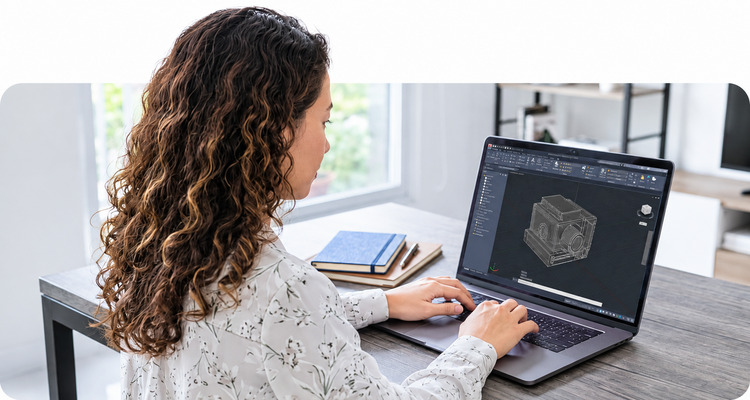
Software and file knowledge
Shopify’s guidance describes Maya as an industry standard and Blender as a free option that suits newcomers and works for previewing files. 3ds Max and Substance Painter, used for painting textures and exporting GLB, round out the common toolkit. Files your web developer can’t open create extra work, so match the format to the destination.
Judgment about detail
More polygons produce a heavier file, and heavier files load slowly on a phone. Shopify’s checklist says a model should respect the polygon limits of wherever it will be used, such as AR Quick Look or VR.
Skilled modellers work out that budget before starting and can explain the choice for each product.
Evidence in the portfolio
Wireframe views and untextured clay renders beside the finished images reveal the structure under the surface, and polished renders alone hide it. A small paid test settles the rest.
Send reference photos and measurements for one of your own products, then compare the result against the real item.
Shopify’s standard is a model that matches the reference photos and can be inspected through a full 360 degrees.
Can AI Replace a 3D Modeller?
Text-to-3D generators have improved quickly, and the vendors say so today. Tripo AI’s April 2026 announcement for its Smart Mesh P1.0 model claimed engine-ready assets in as little as two seconds.
Here’s the clincher:
The same announcement admitted that many generated assets have needed substantial manual cleanup, with artists rebuilding topology or repairing geometry before use.
So, no. Not if you want a 3D model that won’t have glitches. One that’s tailored to your product specifications. And it doesn’t end with the render itself, no matter how precise or flawless. User experience (UX) and branding. Will it give users an easier time getting a grip on all the sides of the product and what it is? Does the render match branding?
Your products are specific objects with specific dimensions, finishes, and logos. Generators? Prompts? They can’t check a model against the physical item. They can’t do specific, out-of-the-box changes.
Shopify’s checklist, with its demand for true size and a match to the reference photos, describes work that someone has to verify against the real thing.
Though AI generation can speed up rough drafts, your modeller has to answer for the final file. The human in the loop.
How Much Do 3D Artists Get Paid in Australia?
Published figures are scattered, and it helps to see them in one place before you set a budget.
Job titles that cover very different work. Whether you need product visuals for your online store or VFX for a short film, you might need a different modeller for each. Look at the title, and then look further into the qualifications.
Salary is one page of it whole, when it comes to local hires – the Superannuation Guarantee (check Payday Super Employer’s Guide) has been 12% since 1 July 2025, which turns a base of A 100,000 into A 112,000.
Before payroll tax, leave entitlements, a workstation, possible training needed before onboarding (upskilling, too, after), and software licences.
Remote engagements follow different logic, with offshore studies pricing by asset or episode. Going through managed providers is another thing, too, as their pricing model varies per specialist, depending on experience and expertise.

What to Do After Hiring a 3D Modeller?
Who Holds the Rights to the Files
Under the Copyright Act 1968, an independent contractor generally holds the copyright in what they create unless they assign it in writing. An assignment only takes effect if it’s written and signed.
Work made by an employee in the course of employment gives the employer the copyright (payment alone, or a completed transaction, does not add anything to this).
Whichever structure you use, put the finals and the layered working files in the agreement, and have a lawyer check the wording.
Work Hours and Review Rounds
Let scheduling be transparent with offshore 3D artists. Which hours should overlap with the local team’s? What time are they expected to send updates? What about online meetings? Submissions?
As long as you have everything about work hours sorted, differing time zones won’t at all be a problem.
What Goes in the Brief
Include reference photos of each component, measured dimensions, the destination (product page, print or AR), the file format, and a size ceiling. Remember what Shopify lists as common reasons for rejection. Said details answer those problems.
Extra Read: Thinking of bringing in a specialist who’ll help your brand with creatives? Here are Five Reasons Why You Need to Hire a Graphic Designer.
Remote 3D Modellers Through Remote Staff
If a local search has stalled, don’t keep searching locally. There’s a bit of a challenge in finding the right offshore 3D modellers, especially if there are talent shortages in the territory or city where you run your business.
It’s why, for over 18 years, Australian firms have been entrusting outsourcing to us. We place offshore professionals with Australian and US businesses, and 3D modellers and CAD designers are among the roles clients request.
Candidates are screened for hands-on experience with the software their work depends on, and you can judge them the way this article suggests, with a portfolio review and a small paid test.
Remote Staff handles payroll and onboarding along with HR support. And our support doesn’t stop there. Our roadmap is a long-term one, where we help you grow as your business does, continually providing you with top talent as you expand your workforce along the way
FAQs
What is a remote 3D modeller?
A remote 3D modeller builds digital 3D objects from reference photos, drawings or samples and delivers the files from outside your office. Typical outputs are product page models, still renders, turntable videos and AR ready files.
How much does a remote 3D modeller cost?
Australian salary data runs from about A$60,000 (Payscale, 3D animators) to A$130,000 for mid level film VFX roles, and a local hire adds 12% superannuation on top. Remote engagements can be priced per hire or per project, so the figure depends on scope.
Is Blender good enough for professional work?
Shopify’s guidance calls Blender a free option that suits getting started and previewing files, and lists Maya as an industry standard. The better test is the output. Does the modeller deliver clean, correctly sized GLB or USDZ files that meet your platform’s spec? If so, the software carries little weight.
What file format do I need for 3D product pages?
Shopify accepts GLB and USDZ up to 500 MB and generates both versions for Android and iOS, with 4 MB or less as the usual target. Other platforms publish their own limits, so check the destination before the brief is written.
Do I need a 3D modeller or a CAD designer?
Choose a 3D modeller for visuals that sell or show a product, such as renders and web viewers. Choose a CAD designer when the output feeds manufacturing or engineering drawings and needs exact, measured geometry. Some projects need both.
Extra Read: Discover why businesses are outsourcing Marketing Automation Specialists.
The 3D Specialist You Need May Be Outside Australia’s Backyard
A remote 3D modeller turns reference photos and measurements into files that sell, show, and check a product before it exists on a shelf. The quality of the work – you see it. It comes down to things you can specify and test: file format, real dimensions, clean mapping, and a portfolio that shows the wireframe.
You don’t need a full studio to start. One well-briefed product and a small paid test will show you what the work looks like and whether the modeller suits your business.
Bring the right 3d modeller artist into your team. Request a Callback today.
find the roles you need

Vaune Everis Cura has always been a writer in the truest sense, drawn to the art both as a personal creative pursuit and as a profession. Her experience penning content across digital marketing spaces and collaborating with business owners and market shapers has broadened her craft to include strategic direction and SEO insight. Having spent years with the InterContinental Hotels Group before stepping boldly into freelancing, she understands that at the centre of it all are genuine, meaningful brand–customer relationships built on purposeful, human content.