What Is the Right to Disconnect Law in Australia?
Australia’s Right to Disconnect is a workplace law under the Fair Work Act 2009 that gives employees the right to refuse to monitor, read or respond to work-related contact outside their working hours, unless that refusal is unreasonable. It covers contact from employers as well as third parties such as clients, suppliers and members of the public. The law has applied to larger employers since 26 August 2024 and to small business employers since 26 August 2025.
Small businesses, and, in fact, even growing ones (medium-sized, right before they’re categorized as “large enterprise”) have a Roman handshake on two very human values: goodwill and flexibility.
But after the Right to Disconnect Australia law was thrust into circulation, business owners suddenly did a double-take at their workforce:
Your operations have always been interlaced with employers being reachable. And it wasn’t some underhanded arrangement. No hand-trying, they-had-no-choice-or-else milieu. Your team had always known, and accepted, such realities of a smaller operation
The national system says there’s no Australian business “too small” to be exempt.
How, now, do you keep covering customers and different time zones without inviting scrutiny from the Fair Work Commission…
…and without jeopardizing the work-life boundaries of your local employees?
In This Blog:
- ➤What Is the Right to Disconnect Law in Australia?
- ➤When Did the Right to Disconnect Come Into Effect?
- ➤What Does Contact Mean in Right to Disconnect Fair Work?
- ➤When Does Right to Disconnect Small Business Australia Apply to Your Business?
- ➤What Happens If You Breach the Right to Disconnect Law?
- ➤When You Disagree With the Commission’s Decision
- ➤What Structure Lets You Run Extended Hours Legally?
- ➤How Remote Staff Helps AU Businesses Build Compliant 24/7 Coverage
- ➤FAQs
When Did the Right to Disconnect Come Into Effect?
August 26, 2025 was the date of dates. The Right to Disconnect became an “everyone” rule, no longer exclusive to bigger employers, no longer a size-based exemption. Not anymore, with that limitation (in effect since August 2024) repealed in 2025.
What Is the Closing Loopholes Act in Australia?
It’s a change in legislation, being added to the Fair Work Act (Section 333M). In summary, it makes clear that employees are legally empowered to refuse to monitor or respond to work-related contact outside of their working hours. The proviso being this: that refusal shouldn’t be unreasonable.
More on what comprises “unreasonable” as you read on.
What Does Contact Mean in Right to Disconnect Fair Work?
key takeaway//Quick Answer
Though it’s understood as any form of communication from the employer, “contact” spans contact from clients, other businesses, vendors, partners, and other entities related to the employee’s work, including members of the public.
Communication agreements within the business and teams are relatively smooth; you can tell your manager you’ll no longer be reachable after a certain time of day, and they’ll have no qualms about it.
Talking about the same thing with clients requires a clearer explanation, especially when they’ve grown accustomed to having someone from your business available whenever they need help.
Summary of points under the Right to Disconnect Law Australia:
- After-hours contact isn’t “unlawful” – you can still contact employees outside their working hours; it’s that the employee has the right to refuse to monitor, read or respond, where that refusal is reasonable
- You can’t punish someone for exercising the right – dismissing or taking adverse action against someone because they exercised it creates a separate legal problem (the Right to Disconnect is a workplace right under the Fair Work Act)
- “Small business employer” has a specific meaning – generally means fewer than 15 employees at a particular time; previously exempt from the Right to Disconnect provisions, not anymore since August 2025
- Also check the Modern Award – rules apply in addition to any requirements already set out in the award or enterprise agreement covering your employees
There’s no asking when or to what kind of business the Fair Work Act Right to Disconnect legislation applies, because it just does:
To ALL Australian businesses, so long as you’re covered by the national workplace relations system.
Are businesses getting crippled by it, especially those with smaller operations? What can you do about it?
When Does Right to Disconnect Small Business Australia Apply to Your Business?
“When” it applies is directly entwined with actual dates:
As long as a business, regardless of size or number of employees, belongs to Australia’s national workplace relations system, the Right to Disconnect is already in force.
What Counts Towards The 15-Employee Threshold?
Full-time and part-time employees count towards the threshold. Casual employees generally don’t count, unless they’re engaged on a regular and systematic basis.
Your Business Hours Aren’t Your Employees’ Hours (Unless They Actually Are)
The confusion’s been making its way throughout teams with members stationed all over Australia’s regions and territories and outside – remote or interstate teams. With spread-out staff come scenarios like:
A message appearing outside someone’s usual working hours because of a time-zone difference, or a manager unsure whether they can reasonably expect a response from someone who’s logged off for the day (in their time zone and not the manager’s).
The law doesn’t:
- Prevent an employer from contacting someone outside their working hours
- Prevent the reverse either – employees can contact one another, or their managers and other affiliates of the business – across time zones
The point of the law is the response, or the expectation of a response, outside the employee’s work shift.
What Happens If You Breach the Right to Disconnect Law?
The question is whether the employee’s refusal to engage was reasonable, since there’s no laid-out definition of penalties for breaching the Right to Disconnect small business Australia law.
Should a dispute arise, the employee and employer are to try to resolve it at the workplace (virtual or offshore settings count) first. If they can’t, either party (or both, together) can take the dispute to the Fair Work Commission.
The tribunal can review it and make a decision under the Fair Work Act.
Five Factors the Commission Weighs:
Section 333M of the Fair Work Act sets out five circumstances it must consider:
1. Reason for the Contact (From the Employer or Manager)
Why did you need to reach the employee? Is there a genuine emergency? “Emergency” or anything implying urgency is the keyword, compared to a routine task that can wait until the employee’s back on the clock.
2. Employee’s Role and Level of Responsibility
Someone in a senior role may reasonably be expected to deal with occasional after-hours contact. However, the same expectation may not be reasonable for someone with a narrower role.
3. How the Contact Was Made and How Disruptive It Was
A single email, call, or message may be permissible. If that one time is multiplied and keeps coming through over dinner, a day off, the weekend, or just after shift hours, it’s bound to poke at the Act.
4. Whether the Employee is Paid to be Available or Compensated for Additional Work
There are on-call allowances or other types of compensation that cover availability outside ordinary hours, and the Commission will take that into account.
5. Employee’s Personal Circumstances
Here’s something outside what’s defined as “unreasonable” – caring responsibilities and family commitments. Other circumstances in an employee’s personal life that affect their availability can also be relevant.
The Commission considers these circumstances together.
When You Disagree With the Commission’s Decision
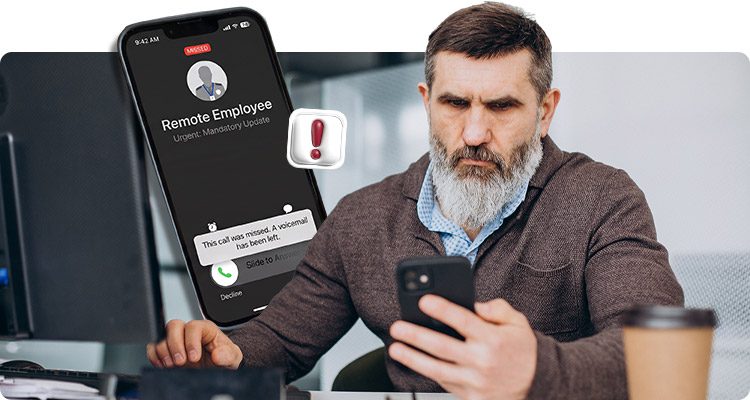
Suppose an employee refuses to answer an after-hours message. You disagree with that decision and, in the heat of the moment, issue a warning. Or cut their hours. Dismiss them. Or some other hostile action.
Now there may be a second issue.
“
Because the Right to Disconnect is a workplace right, an employee who experiences adverse action because they exercised that right may have a general protections claim.
General Protections Guidance
The Commission can also make orders dealing with the dispute itself, and it’s a forked road:
- Where an employee’s refusal is unreasonable, the Commission can order them to stop refusing the contact.
- If a Commission order is ignored, the maximum penalty is currently $93,900 for a corporation and $18,780 for an individual.
There are circumstances where after-hours contact can be reasonable, and circumstances where an employee’s refusal can be unreasonable.
If someone genuinely needs to be available outside ordinary hours, everything about their role and job description should outline that clearly. Expectations should be clear.
Does the Right to Disconnect Law affect contractors?
Stamping a role with the name “Contractor” doesn’t absolve obligations under the Fair Work Act.
Case in point, and quite literally a well-known “case,” is Pascua v Doessel Group Pty Ltd [2024] FWC 2669. A paralegal based in the Philippines was engaged by a Queensland law firm as an independent contractor.
Among the things the Commission looked at were:
- How much control the firm had over her day-to-day work
- How closely she was integrated into the business, including using an email signature that identified her as a staff member
- Her financial dependence on a single client
Yet the Fair Work Commission found that she was an employee for unfair dismissal purposes.

What Structure Lets You Run Extended Hours Legally?
The Right to Disconnect, also referred to as “after hours work laws Australia,” emphasises the employment relationship rather than employer-employee physical locations. It concerns the employment relationship under the Fair Work Act, rather than a person’s physical location.
For instance, an Australian business can use offshore staff employed by a licensed staffing provider in their own country, under local employment laws, with their own daytime hours.
That can provide coverage for Australian customers outside the local team’s working hours, without asking those Australian employees to remain available after their shift.
The key is the employment arrangement. A genuine staffing structure can provide extended coverage, onshore or offshore; mislabelling an employment relationship as contracting isn’t the answer.
How Remote Staff Helps AU Businesses Build Compliant 24/7 Coverage
We do it by pairing Australian businesses with the right offshore specialists. Remote Staff has an 18-year placement history with AU SMBs. Staff placed through our team are employed under proper local arrangements – they’re not covered by Australian employment laws and obligations.
Whether full-time or part-time (then, later, to be made full-time, when business grows) is up to you. Payroll, onboarding, and HR support are on us.
But placement isn’t our only expertise. Long-term support as you scale your operations. We’re there with you, helping you adjust staffing and grow your workforce year upon year, or as needed.
That way, you’re never stuck sifting through hundreds of resumes whenever the need for a role arises.
Extra Read: Know more about Same Job Same Pay Australia.
FAQs
Can you discipline an employee for not answering an after-hours call?
No, you cannot, and doing so is counted as adverse action under the general protections of the Fair Work Act. It’s explicitly noted in the Right to Disconnect that employees are not obligated to answer or respond to communications outside their work hours.
Does the Right to Disconnect cover phone calls, or just emails and texts?
It covers phone calls, emails, texts, and any other form of contact or attempted contact, or communication. It’s also not limited to specific apps or communication channels, but comprises any means of communication. The Fair Work Commission looks at the same five factors regardless of how the contact was made.
Do casual employees have the right to disconnect?
Yes, casual employees are covered by the same right as full-time and part-time staff. That said, casuals only count toward that 15-employee threshold if they’re engaged regularly and systematically.
Does the right to disconnect apply to employees working from home?
The location of the employee doesn’t change whether the right applies. What matters is whether they’re an employee under the national workplace relations system and whether the contact falls outside their agreed working hours, regardless of whether they’re in an office, working remotely from home, or based interstate.
A remote employee (within Australia) has the same protection as someone working from the business’s premises.
What should you do if you think an employee’s refusal to respond was unreasonable?
Raise it with the employee first. The Fair Work Commission expects both parties to attempt resolution at the workplace level before either side escalates a dispute. If it can’t be resolved internally, either the employer or the employee can apply to the Commission, which can deal with the matter through conciliation, mediation, or arbitration.
You Can’t See Their Home Office, But You Still Need to Look After Your Team
Remote work can make the little things harder to notice. You know this if you already have one or several hybrid or remote teams. It’s harder to spot changes in behavior. Exhaustion. Less motivation. Personal problems that seem to be affecting your employee’s overall approach to work. Isolation, even.
You can’t manage every corner of an employee’s home – you’re not expected to, and it’s also not the thing to do. In fact, don’t. Instead, you can give people a safe way to raise concerns. Give them guidelines on how to pay attention to the risks that come with the way work is organised, and put sensible controls around the things you can influence as owner or manager.
Your people may be working from the other side of the city, or the world. They’re still people doing work for your business. Give them the structure and support to do that work safely.
Still not sure about how to approach this? Let us help. Request a Callback today.
find the role you need

Vaune Everis Cura has always been a writer in the truest sense, drawn to the art both as a personal creative pursuit and as a profession. Her experience penning content across digital marketing spaces and collaborating with business owners and market shapers has broadened her craft to include strategic direction and SEO insight. Having spent years with the InterContinental Hotels Group before stepping boldly into freelancing, she understands that at the centre of it all are genuine, meaningful brand–customer relationships built on purposeful, human content.