What is a photo editor?
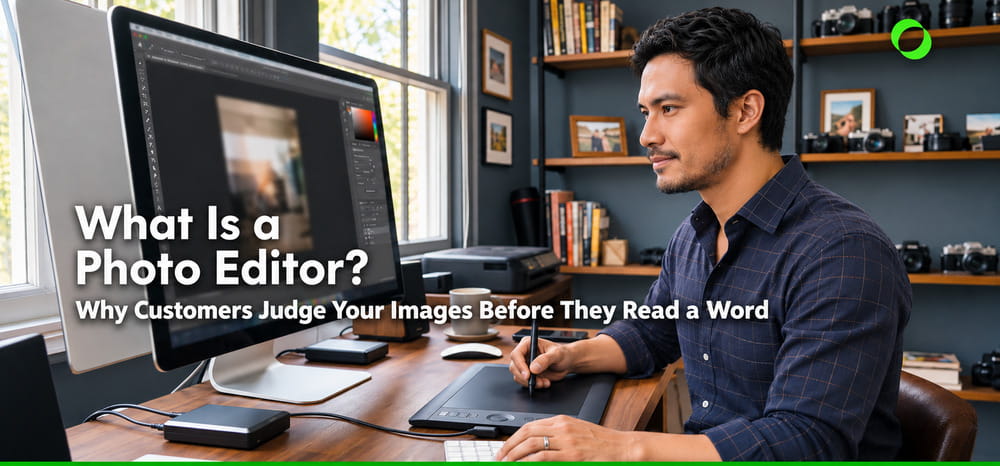
A photo editor is a professional who corrects, retouches, crops and prepares images so they suit a platform, a brand standard and a purpose. In a business, that covers the pictures your customers see before they ever speak to you. Career guides such as CareerFAQs describe the role as enhancing and curating images for media platforms.
Customers open a product page and boom – they see the product name. They see the product description and details.
All scanned without really reading every single word; probably skipping over some lines here and there. But before they even reached this part of the hunt and eye-wandering, they’ve already gone over the product images.
It’s why they’re still reading on.
It’s because the shots look professionally done. Crisp and sharp. Nothing pixelated or grainy. Nothing blurry. Lighting in the background isn’t overkill. The shots tie together with the same branding and theme.
But without the photo editor expert, you’ll have none of these. The cold, hard truth.
Australian businesses have done it without paying attention to their product photos and related lifestyle images, trusting that the quality of their product will get them through.
Does it work, though?
This article goes over why SMBs are getting out of this DIY, we-don’t-put-much-effort-in-our-photos practice and are outsourcing photo editors; many, bringing them into their hybrid teams permanently.
In This Blog:
- ➤What is a photo editor?
- ➤What Does a Photo Editor Do?
- ➤When Should You Hire a Photo Editor?
- ➤What Skills Does a Photo Editor Need?
- ➤Is an Online Photo Editor Tool Enough for a Business?
- ➤Is It Legal to Edit Photos for Property Listings and Product Ads in Australia?
- ➤What Are the Risks of AI Photo Editing?
- ➤How Much Does a Photo Editor Cost in Australia?
- ➤How to Hire a Photo Editor Remotely
- ➤Zooming In on Partnering With Managed Providers for Photo Editors
- ➤FAQs
- ➤Your Images Meet Customers First
What Does a Photo Editor Do?
The tasks of every photo editor vary by industry, but most roles draw on the same toolkit.
What Are Some Photo Editing Tasks and Services for Businesses:
If you’ve gone over a couple of resumes, you may have noticed that some roles are heavy on production. Hundreds of images moving through each week to a fixed recipe. Others are more on the creative judgement side, such as matching a seasonal mood or deciding which shots represent the brand best.
What specific tasks do you need done for your brand? List these down. Talk about it with your team.
When Should You Hire a Photo Editor?
You hire one when image work has become regular and too important to leave to rushed, DIY fixes.
The professional take: This might sound too salesy, but if your vision is to see your business travel on a sustainable trajectory, “team member” is the right perspective when planning for the hire.
That said, here are some factors to consider:
- Product shots from two suppliers and three shoots no longer look related to each other.
- Someone on your team spends part of every week resizing and recolouring files, a job nobody was hired to do.
- Launch dates slip because the images are late, and the copy has been finished for a week.
- Your catalogue, listings or locations are multiplying, and the editing multiplies with them.
- A customer returned an item because the colour in the photo wasn’t the colour in the box.
Log the hours your team spends on image tasks throughout a fortnight. Multiply by what that costs you – the starting figure for your image editor hire.
What Skills Does a Photo Editor Need?
Photo Editing Software
Australian job ads for the role keep naming Adobe Lightroom and Photoshop, with Canva added where social media graphics are part of the week. Software proficiency gets a candidate to the test task. It doesn’t separate the strong ones from the rest.
Creative Judgment/Artistic Vision
Experts in the industry also like to call this “artistic instinct” or “aesthetic sensibility.” A kind of “taste” that’s more of an X factor behind the skills of the best photo editors.
It’s the ability to exercise restraint and maintain consistency (artists tend to want to create something completely new or novel with their work, but working with a brand means staying true to its identity every time).
Whether it’s a 3-part reel or 8 product images, strong editors can make them look like one shoot.
Reading Briefs Properly
Images bound for a marketplace listing. A print brochure. Paid ads. These need three different treatments, and the editor knows why.
Communication, too
Important especially in remote and hybrid teams. Much more than owners expect (those going the remote route for the first time). Expert professional photo editors don’t shy away from asking questions before they carry out the work and make creative decisions themselves.
Is an Online Photo Editor Tool Enough for a Business?
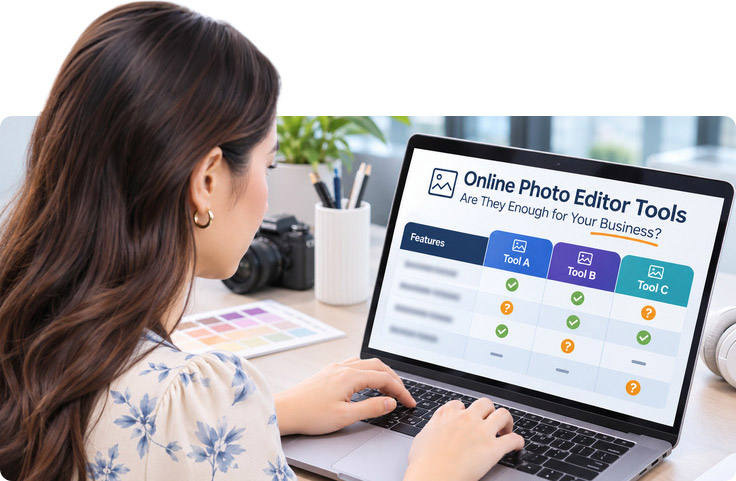
Yes. Online tools like Canva and Adobe Express are useful for everyday tasks such as resizing images for websites and social media, and creating basic promotional graphics with text, logos, and simple background edits.
There’s a limit, of course. It’s that they apply a setting to an image without fully “knowing” your brand and your platform (because they’re tools without the human creative mind behind them). or whether that fabric is really teal.
For recurring image work, new product batches, campaign materials, and anything where brand consistency needs to hold over time, a dedicated human photo editor is a better fit.
They get familiar with your visual standards and can root them into each new batch of work.
What about AI features and their risks?
We cover this below.
Is It Legal to Edit Photos for Property Listings and Product Ads in Australia?
Editing is legal. What isn’t is misleading people. And this applies to any other form of advertising or marketing, where the images and claims used to sell a product or service must accurately represent what customers can expect.
I’d divide it into two sections, separating the legal obligations from the practical risks of AI editing.
What Does Australian Consumer Law Say About Edited Images?
key takeaway//Quick Answer
The Australian Consumer Law prohibits misleading or deceptive conduct in trade or commerce, and images count as much as words.
Jeannie Paterson, a consumer protection law professor at the University of Melbourne, told CHOICE that a manipulated property image may be misleading and deceptive conduct, and that the test is whether it is likely to mislead. Nobody has to prove a loss.
Different States Have Their Own Rules About Edited Images in Australia
CHOICE’s November 2026 report says New South Wales legislated in September to require agents to disclose AI use in images that could deceive tenants, and that any AI alteration of real estate images must be disclosed there, including AI-generated furniture.
Queensland requires agents to label AI-generated images clearly and disclose any difference between the image and the actual home.
What Are the Risks of AI Photo Editing?
AI editing carries its own failure mode. In one Mullumbimby listing CHOICE examined, an agency used AI to clear leftover items from a house. The tool also redesigned the kitchen bench and installed a new oven and cupboards.
A June 2026 survey found that 70% of Australians disagree that businesses should be trusted to use AI however they see fit.
Customers are highly visual. “Visual” or “what they immediately see” is mainly what allows them to form impressions of a business from the images they encounter on its website, product pages, and social media.
When those images look artificially altered or misrepresent what a product or property really looks like, customers may question the information you’re putting out there about your products and brand. It affects your credibility.
Use the sample below (add to the list as you deem fit) for your picture editors:
- List the approved edits, such as exposure, white balance, straightening and lens correction.
- List the banned ones: removing permanent features or defects, changing room proportions, adding fixtures.
- Require the editor to log any AI tool used, and keep the original files.
- Check your state regulator’s rules before using virtual staging. This is general information and a lawyer or your industry body can confirm the detail.
If images have been edited too heavily, even an otherwise good product can end up with disappointed buyers and avoidable returns.
How Much Does a Photo Editor Cost in Australia?
Photo editor salaries vary across Australia, depending on the source, location and type of work being measured. Here’s how the available figures compare:
Two of those are salary data from different sample pools. One is a per-task price from a marketplace, and it can’t be compared with a salary directly.
As always, when it comes to salary averages and comparisons, none of the salary figures above include on-costs. The Superannuation Guarantee (read our Payday Super Employer’s Guide) has been 12% since 1 July 2025, so an AU 80,000 base adds AU 9,600 in super before leave, payroll tax, equipment and software licences.
Hiring outside Australia changes which of those on-costs apply, so ask any provider for the all-in figure rather than the base rate.
Direct Channel
Have questions? Drop our team a line anytime.
How to Hire a Photo Editor Remotely
Image work suits remote arrangements because the files travel and the output is easy to inspect. These steps keep the hire predictable.
- Name the image types: Product shots, portraits, property sets, and social assets each need a different editor’s eye.
- Write the standard down: Before-and-after examples, a brand guide, or a folder of reference images turns “make it look good” into something checkable.
- Fix the software and file rules: This one’s about settling the tools, export sizes, colour profile, and naming convention before the first file moves.
- Run a paid test on real images: A portfolio shows range. A test on your own files shows fit, and how the candidate handles questions.
- Agree on response windows. Public holidays vary by state in Australia, and Labour Day alone falls on four different dates, so give the editor the calendar for the state that approves your work. A remote editor in a different time zone can turn files around overnight, but only when the brief is complete before the Australian day ends.
- Set up one workflow: One place for briefs, one for feedback, one folder structure with raw, working, and final files, and clear version names. Share only the folders the job needs, especially for unreleased products.
Mistakes to Avoid When Hiring a Remote Photo Editor
- Choosing the lowest rate – Redone edits cost more than the savings, and the redoing lands on your staff.
- Briefing in a single line – An editor who doesn’t know whether the image is for a premium campaign or a marketplace listing will make sensible choices that are wrong for you.
- Letting four people send feedback – Conflicting notes slow delivery and confuse the editor, so nominate one reviewer.
- Skipping batch rules – Any set of images needs agreed crops, colours and backgrounds from the start.
- Accepting heavy retouching – over-edited images look artificial and cost trust.
The bottom line is that it’s always best to lay down all the details, from work engagement and pay to the daily responsibilities of your photo editor, before onboarding.
Zooming In on Partnering With Managed Providers for Photo Editors
If you’d rather skip the sourcing and testing stage (time- and cost-exhaustive, if you think about it), Remote Staff is one option Australian businesses use.
We’ve been placing remote professionals with Australian businesses for more than 18 years. We screen candidates on demonstrated work and handle payroll, onboarding, and HR support.
Whichever route you take, the paid test stays. Portfolio samples in your own category, whether product, property or portrait, tell you more than a résumé does.
We also remain your long-term growth partner, providing you with the ideal specialists as your business and workforce grow.
FAQs
What is the difference between a photo editor and a photographer?
A photographer captures the image with a camera. A photo editor works on the files afterwards, correcting colour, retouching, cropping and preparing them for use. Some people do both, but the skills are separate.
How much does a photo editor cost in Australia?
Published salary averages run from AU$72,500 to AU$90,000 a year depending on the source, and marketplace tasks start around AU$31. Super at 12% and other on-costs come on top for a local employee.
Can a photo editor work remotely for an Australian business?
Yes. The work is file based, so location has no bearing on the output. You need clear briefs, agreed turnaround times and one shared system for files and feedback.
Is it legal to edit photos for property listings in Australia?
Editing is legal, and misleading viewers is not. Under the Australian Consumer Law, an image that is likely to mislead can breach the rules, and NSW and Queensland now have specific obligations around AI altered images.
Which software should a photo editor know?
Adobe Lightroom and Photoshop are the names that appear most in Australian job ads, with Canva added for social media work. Ask for evidence of finished work in the tool you use.
Extra Read: Protecting your brand and its visual identity, particularly when using real people’s likenesses in marketing materials: Denmark AI Face Copyright Law.
Your Images Meet Customers First
Pictures reach your customers before your sales team does, before your copy and before your prices. They’re judged in a glance, and a glance has no patience for mismatched crops or a colour that disappoints.
Your images need attention long after the first batch goes live. New products arrive, campaigns change, and old listings need updating.
Having a photo editor on hand means someone can take care of those requests as they come in, without your team having to squeeze another round of editing into an already busy week.
If your team is still resizing files on a Friday afternoon, you already know where the hours go. Reach out to us and Request a Callback.
find the role you need

Vaune Everis Cura has always been a writer in the truest sense, drawn to the art both as a personal creative pursuit and as a profession. Her experience penning content across digital marketing spaces and collaborating with business owners and market shapers has broadened her craft to include strategic direction and SEO insight. Having spent years with the InterContinental Hotels Group before stepping boldly into freelancing, she understands that at the centre of it all are genuine, meaningful brand–customer relationships built on purposeful, human content.