

IN THIS BLOG:
- ➤ What Is a Marketing Automation Specialist? The Role In a Nutshell
- ➤ Key Responsibilities: Marketing Automation Specialist Job Description
- ➤ Marketing Automation Tools: What Platforms Do Automation Specialists Use?
- ➤ Are You Ready For Marketing Automation? How To Self-Diagnose Your Business
- ➤ Six Types of Marketing Automation Specialists (and Which One You Need)
- ➤ What Does a Marketing Automation Specialist Cost in Australia?
- ➤ Why Australian Businesses Are Hiring Marketing Automation Specialists Remotely
- ➤ FAQs
Your automation platform has been live for months. Nobody’s been hired to run it. That’s the whole problem.
85% of Australian SMEs are paying for tools they don’t realise are barely being used. That’s more than half of local businesses owning marketing software that’s basically sitting in their systems.
Is your business one of them?
The answer usually isn’t a missing platform. It’s missing marketing automation specialists.
Most business owners either underestimate the role or hire the wrong version of it. Here’s what you should know about marketing automation, and how to find the specialist that fits your operation.
What is a marketing automation specialist?
A marketing automation specialist takes your software, like HubSpot, Klaviyo, or ActiveCampaign, and builds the operational logic inside it. They configure the system to handle lead scoring, email sequencing, and behavioural triggers such as abandoned carts. Essentially, they ensure your marketing runs on its own based on exactly how your contacts interact with your brand.
What Does a Marketing Automation Specialist Do? The Role In a Nutshell
Marketing automation specialists take your marketing strategy and configure the technical logic inside your tools so it runs without manual input. They build email sequences triggered by contact behaviour rather than fixed send dates.
The customer journey piece is where most businesses are weakest: a first-time visitor and a returning buyer need different messaging at different moments, and a specialist builds the system that delivers both.
Most businesses don’t know how much depends on having this person until something breaks.
Illustration: Oliver is a Sydney-based e-commerce founder. He purchased HubSpot, assuming that his marketing coordinator could handle it. Several months later, workflows are weakly built, the CRM data is cluttered, and the sales team is going after cold leads as if the software didn’t exist.
Without someone who knows how to configure it for his specific operation, HubSpot isn’t supporting his business. Just another line item on his monthly expenses.
Key Responsibilities: Marketing Automation Specialist Job Description
What does a marketing automation manager do? This specialist oversees technical aspects like configuring systems and maintaining data integrity. They help ensure that the right message reaches the right contact at the right funnel stage.
Here is what that looks like in practice.
Automated Email Workflows
Product page visits, form submissions, or purchases are triggers of email sequences and drip email campaigns. Rather than inputting a fixed send date, a specialist configures your tools so that your contact’s actions or responses determine when they hear from you and what they receive.
Lead Scoring and Prioritisation
Not every contact in your database is at the same stage, and not all of them warrant the same amount of your sales team’s time. A specialist sets up lead scoring to rank contacts by their likelihood to convert, and your sales team works from a prioritised list.
CRM Data Management
Your CRM is only as useful as the data inside it. The data has to be “clean.” The records have to be accurate and consistent enough to be trusted. A specialist keeps them deduped and synced across your marketing platform and sales tools so both teams are always working from the same information.
A/B Testing and Optimisation
Subject lines, send times, calls to action: a specialist regularly runs these tests and acts on the results. They make incremental improvements based on what the data shows.
Over time, those small adjustments compound; better open rates, higher click-throughs, and sequences that convert.
Customer Journey Automation and Mapping
A first-time visitor needs different messaging than someone who has already purchased. The specialist maps out each stage of the customer journey and aligns your workflows accordingly, so every contact receives communication that matches where they actually are.
Marketing Automation Tools: What Platforms Do Automation Specialists Use?
Platform choice depends on where your business is:
- SMB and mid-market: HubSpot, ActiveCampaign, Klaviyo, Mailchimp
- Enterprise and larger SMEs: Salesforce Marketing Cloud, Marketo, Pardot
- Integration layer: Zapier, Make, Segment
A specialist who has spent three years building inside Salesforce Marketing Cloud operates at a different level than one who has surface-level familiarity with five tools.
One common mistake when hiring is screening candidates based on platforms they’ve previously used. Maybe you’re looking only at a HubSpot automation specialist or a Marketo automation expert. The right call is to match them to the platforms your business uses.
Are You Ready For Marketing Automation? How To Self-Diagnose Your Business
Readiness for this hire is rarely straightforward. The truth is, specific, recurring patterns are easy to dismiss individually. But collectively, they’re expensive to ignore. These are four to watch for.
#1. Paid Platforms
Your automation tool has been live for over a year. You’re charged for its subscription monthly. But most of the features that were set up once run with no oversight. Some haven’t been touched at all. You’re covering the cost of a capability your business is not using. In most cases, nobody on the team has been assigned to change that.
#2. The Manual Funnel
The sales team is still sending follow-up emails by hand. They copy campaign sequences whenever a new one is needed. They track leads and lead stages in a spreadsheet. They’ve been doing these tasks the same way they’ve done so before you purchased the software.
Now that the platform exists, the processes haven’t changed. There’s no sales funnel automation. Both the manual effort and the tool are running side by side, and yet the latter is barely involved.
#3. Data Disconnect
Your CRM and automation platform do not reliably converse with each other. The handoff between marketing and sales doesn’t garner good results because contacts fall through.
Someone asks where the lead is from. Someone asks why it wasn’t followed up on. Nobody has an answer.
#4. The Headcount Reflex
Every time volume increases, your response is to hire another person to manage it. Operational costs grow in direct proportion to revenue; an unscalable model. It’s the same system copying itself at a higher cost.
What To Do: Two or three of these patterns showing up in your business is enough to justify starting the search. You do not need all four.
Types of Marketing Automation Specialists (and Which One You Need)
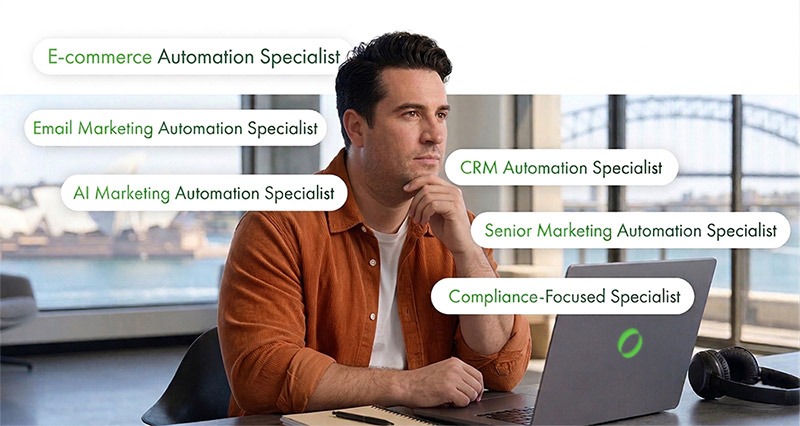
The title “marketing automation specialist” covers more ground than most business owners are aware of. To hire marketing automation specialists that fill your business needs, learn how to identify the ideal fit for your team.
#1. Email Marketing Automation Specialist
This specialist focuses on email sequences, from welcome flows, lead nurturing strategies, to re-engagement campaigns. If your primary conversion mechanism is email and your sequences were built by someone who has since left the business, this is where the problem starts.
What To Do: Check your open rates over the last four to six months. If they haven’t moved, or if nobody on your team can explain why a sequence was structured the way it was, this is your specialist.
#2. CRM Automation Specialist
Managing contact lifecycle stages, lead routing, pipeline automation, and data integrity between your marketing and sales platforms is this specialist’s space. When your sales team regularly complains about lead quality, the issue is usually the scoring and handoff logic that hasn’t been set up properly.
What To Do: Ask your sales lead or sales team what percentage of the leads coming from marketing are worth following up on. That answer will confirm your need for this lifecycle marketing automation expert.
#3. AI Marketing Automation Specialist
By configuring AI features inside your existing platforms, this specialist activates predictive lead scoring and segmentation, dynamic content, and optimises send-time.
For most Australian SMEs, this doesn’t mean hiring someone who builds AI models from scratch. It means hiring someone who can switch on and configure the AI capabilities already sitting inside HubSpot or Salesforce that nobody has enabled or used.
What To Do: Log into your current platform and look for any AI or “smart” features. If none are active or configured, that tells you why you need a marketing automation expert.
#4. E-Commerce Automation Specialist
This is particularly relevant for Australia’s large DTC and Shopify-native market. The automation specialist understands abandoned cart logic, post-purchase sequences, predictive segments, and loyalty flows.
The mindset is different from B2B automation, since the automation is built around purchase behaviour data as opposed to just lead scoring.
What To Do: This is the hire if you sell direct-to-consumer, and your post-purchase or retention flows either don’t exist or are still running on default settings.
#5. Compliance-Aware Automation Specialist
This one is also specific to the Australian market. The Spam Act 2003 governs all commercial electronic messages sent to or from Australia. It requires consent, clear sender identification, and a functional unsubscribe option honoured within five business days.
The Privacy Act 1988 and the Australian Privacy Principles govern how customer data is collected and stored. Repeat violations can carry penalties of up to AUD $2.2 million per day, enforced by the Australian Communications and Media Authority.
A specialist who understands these requirements builds compliance into your workflows from the beginning. One who doesn’t leave your business exposed.
What To Do: Before any automation system goes live, verify that your specialist has working knowledge of both the Spam Act and the Privacy Act.
#6. Senior Marketing Automation Specialist
From scoring models, lifecycle stage mapping, platform migrations, to attribution reporting, this specialist owns the architecture.
This is not a first hire. It’s the right choice for businesses that have had their automation programs running for quite some time. Something has already been built. The person who built it is no longer a part of the team, and none of your current employees understands what’s running.
What To Do: If your existing setup was inherited and nobody on your team can fully explain how it works or why it was built that way, this is the role that fixes it.
What Does a Marketing Automation Specialist Cost in Australia?
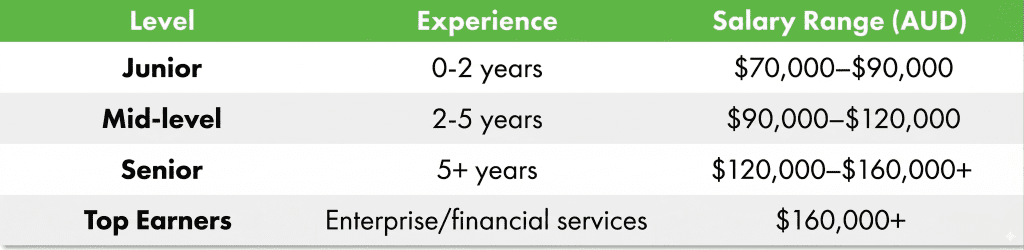
Salary figures for this role vary depending on the source, the platform specialisation, and the industry. This is a straightforward breakdown based on 2024–2025 data from Glassdoor AU, PayScale AU, and Brightbox Consulting:
Marketing Automation Salary By Experience Level:
The “Loaded Cost Gap”
The number on the job posting is not what you spend in year one. Add superannuation (11.5% as of 2025), recruitment fees, onboarding, and the first 30–60 days of productivity ramp. An AUD $95,000 base salary becomes AUD $130,000–$140,000 in total year-one cost.
What To Do: Build your budget against the loaded cost. If that number is beyond your current stage, the remote hiring model is where the math changes.
Why Australian Businesses Are Hiring Marketing Automation Specialists Remotely, With Remote Staff
That loaded cost is what pushes most Australian businesses toward remote hiring. Qualified specialists are in short supply locally, and the ones with real platform depth know exactly what they’re worth.

Remote Staff has been placing technical marketing professionals with Australian businesses for over 18 years. Candidates are screened for actual platform builds and measurable results.
Engagements are structured around where your business is: full-time, part-time, or project-based, with payroll, onboarding, and compliance handled on your behalf.
Marketing automation is the fastest-growing segment of Australia’s digital marketing software market. The qualified specialist pool hasn’t kept pace. That lag is where Remote Staff operates.
FAQs
Do I need a dedicated marketing automation specialist, or can my existing digital marketer handle it?
It depends on what your digital marketer was hired to do. Most are focused on content, campaigns, and channel management, and not the technical configuration of workflows, lead scoring, and CRM integration. If your platform is underperforming and nobody on your team owns it technically, a dedicated specialist is the practical answer.
How long before we see measurable results?
For businesses with a clean CRM and an active platform, most see measurable movement within 60 to 90 days. If the foundation needs work first (unorganised, inaccurate data, disconnected tools, or sequences that have never been properly built), allow a full quarter before expecting consistent output.
What’s the difference between a marketing automation specialist and a CRM manager?
A CRM manager focuses on the database, including contact records and pipeline stages. A marketing automation specialist works with the logic that runs on top of that data, such as workflows, scoring models, and integrations. In smaller teams, the roles overlap, but they are distinct functions.
Does Australia’s Spam Act Affect Automation Workflows?
Yes, directly. Every commercial electronic message sent to or from Australia must meet three requirements: recipient consent, clear sender identification, and a functional unsubscribe option. A specialist builds these requirements into your workflows as standard.
The System Is Already There and Needs Someone to Run It
HubSpot, ActiveCampaign, Salesforce, Klaviyo: all capable platforms. What most Australian SMEs are missing isn’t better software. It’s the person who owns it.
Marketing automation specialists are the reason your CRM stays clean, your leads get scored correctly, your sequences improve over time, and your sales team stops chasing contacts that were never ready to buy.
Find that specialist, define the scope, and let the system do its job.
Unsure where to start? Call us today or request a callback or just fill the form for your free consultation.

Vaune Everis Cura has always been a writer in the truest sense, drawn to the art both as a personal creative pursuit and as a profession. Her experience penning content across digital marketing spaces and collaborating with business owners and market shapers has broadened her craft to include strategic direction and SEO insight. Having spent years with the InterContinental Hotels Group before stepping boldly into freelancing, she understands that at the centre of it all are genuine, meaningful brand–customer relationships built on purposeful, human content.