
In This Blog:
-
The Part Less Talked About: What Does It Take to Run An Agrisolar Hub in Australia?
-
➤FAQs
Sheep grazing and utility-scale solar generation. Sounds like they don’t belong in the same sentence. They do now.
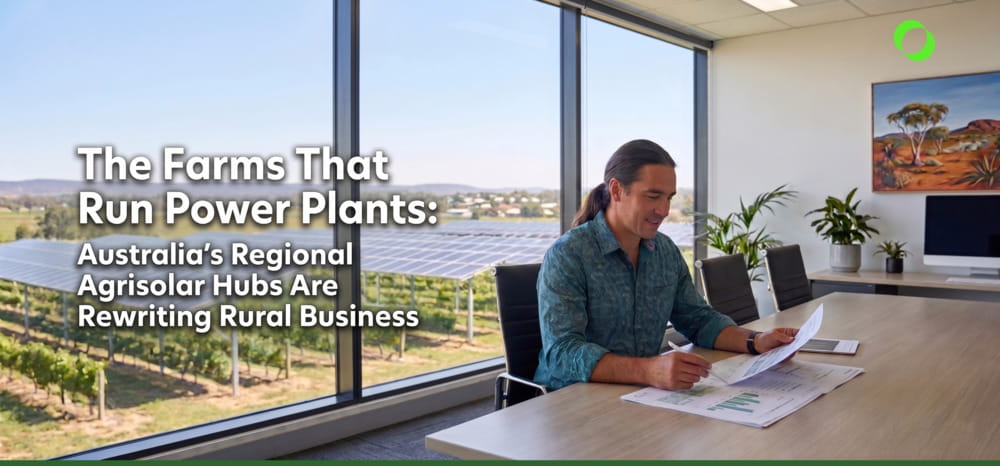
Australia is pioneering a new type of operation that makes farms more than farms: the “agrivoltaics hub.” Also called the agrisolar hub.
A cotton farm is building a facility that produces green hydrogen and ammonia using solar power. Regional farms are being transformed into integrated energy producers.
It’s land use for farming and solar generation simultaneously. It’s landowners building these hubs on their own land to power themselves. What follows is a self-powered farm and a supply chain that’s independent of overseas logistics chains.
But what does it actually take to build and run a hybrid operation?
What does the back-office infrastructure look like when a farm becomes a regulated energy and chemical producer?
What is an agrivoltaics hub? (What is an agrisolar hub?)
An agrivoltaics, sometimes referred to as an “agrisolar hub,” is a facility that co-locates agricultural production with renewable energy infrastructure on the same land. In the most advanced current examples, like GEGHA in New South Wales, the energy produced on-site powers the agricultural operation, replacing imported fuels and fertilisers with locally generated alternatives.
What is an Agrivoltaics Hub Australia a.k.a. Agrisolar Hub: Definition and Purpose
Agrivolatics hubs are converted land so that they’re no longer used only for farming, but for solar farming Australia (systems) and solar energy generation. On the same plot. At the same time. Instead of replacing agriculture with renewable infrastructure, the two operate side by side.
In Australia, the term is often interchanged with “agrivoltaics.” Same definition.
What Makes Agrivoltaics Research Hubs Unique?
Besides crops growing beneath elevated panels and livestock grazing between solar arrays, the energy produced on agrivoltaics hubs can help power the farm itself. Solar grazing systems, if you will. It can even power nearby operations or larger industrial processes like hydrogen and ammonia production.
No more costly freight chains stretching across oceans. No more weeks- to months-long waits for critical farm inputs to reach Australian shores.
This one integrated system, through agricultural solar integration, is what the next generation of agrisolar hubs in Australia is hurtling toward.
Where It Really Started
This sustainable, regional farming tech Australia innovation began with sheep roaming under solar infrastructure. The first of the rest of the agrisolar projects. The Royalla Solar Farm introduced this operation in 2015, making it the baseline model since. It works because grazing stock fit naturally under standard panel mountings and don’t interfere with energy output. Low-tech, effective, and increasingly common across regional NSW, Victoria, and Queensland.
Today, the category has grown well beyond the woolly and the merino. Elevated panel systems allow cropping underneath. Horticulture trials are being done on partial shade structures, and aquaculture testing on floating PVs (floating solar panel systems installed on bodies of water).
At the more advanced end of this renewable energy agriculture shift is solar infrastructure, now being used to power hydrogen and ammonia production directly on-farm. That’s what this article will be diving into.
Extra read: learn about the Modern Slavery Act Australia, guidelines, and how SMBs should stay compliant.

GEGHA: The Model Everyone Will Be Watching
The Good Earth Green Hydrogen and Ammonia project, or GEGHA, broke ground in May 2026 and gave Agrisolar the momentum to push past the experimental.
It’s a joint venture between New Zealand-based Hiringa Energy and Moree’s own Sundown Pastoral Company. The latter operates out of Keytah Farm, one of the largest cotton and cropping operations in the region.
The farm used to import fossil fuel-based fertilisers from overseas or have them transported from Sydney, Brisbane, or Newcastle. With GEGHA, it will produce its own green hydrogen and ammonia on-site using solar power, which it then uses as fertiliser for its own land and neighbouring agricultural properties in the New England region.
$71.6M combined with 65,000 acres, and the project is forecasted to produce 4,500 tonnes of low-carbon ammonia a year.
An Isolated Project No More
GEGHA is the most concrete example yet of a pattern forming across regional Australia: the merging of farming operations and renewable energy infrastructure.
“
Agrisolar CRC is launching a 10-year, $100M industry-led research program running from 2026 to 2036; this will allow industry, landholders, government, and research partners to expand agrisolar commercially across Australia.
10-Year Commercial Expansion Program (2026–2036)
Here’s what’s being coordinated and funded for agrisolar, further signaling that it’s evolving into its own sector:
-
NSW Government has committed $45.2 million to GEGHA alone
-
NSW Hydrogen Hubs Initiative has invested $109.3 million into projects across Hunter, Port Kembla, and Moree since 2023
-
The initiative is targeting 700MW of green hydrogen capacity by 2030
Most Australian SMEs reading about GEGHA and similar projects think this is all about the technology and the investment figures. But the more important question is what it takes to run one of these operations once the panels are up and the electrolyser comes alive.
The Part Less Talked About: What Does It Take to Run An Agrisolar Hub in Australia?
A “farm with solar panels” has always been too simplistic and slightly wrong as an understanding of AU agricultural solar hubs. Though the hype tends to circle around the tech and mechanisms, and they are impressive, there’s something else about self-powered agriculture that’s not getting as much attention:
The back-office challenge. It’s as important as the front-end engineering and technology, and nobody’s talking about it.
A regional agrisolar hub is an agricultural operation, a licensed energy generator, a chemical manufacturer in GEGHA’s case, and a participant in multiple regulatory frameworks, collectively. That’s a lot of hats, and a lot to juggle, for a pastoral business in regional NSW.
The Regulatory Side Is A Major Undertaking
When you run an agrisolar hub, you answer to multiple regulators at once. Each one has different rules and requirements. Each one holds a different ideal of what “compliance” is and isn’t.
That stack looks something like this.
The Four Regulators Agrisolar Hubs Answer To:
Australia’s regulatory landscape works on a higher standard at present, and expects hubs to be audit-ready. They should provide real-time visibility and evidence: if a hub claims a certain number of solar certificates, or reports a certain output to the regulator, they need to be able to prove it with timestamped and traceable records the moment a regulator asks.
For a cotton farm in Moree, that’s a new and overwhelming side of the business that’s an entirely different professional lane.
Data Demand Is Growing Fast
A hub like GEGHA generates operational data across multiple systems: solar generation and battery storage. Then, electrolysis output, ammonia production, crop monitoring, irrigation, and transport logistics. A lot of data from a lot of systems, and they don’t automatically work together.
These are cotton farms and pastoral properties. To expect software company-level outputs is too much to throw at a farming corporation, no matter the size. They don’t have data teams.
Regulators put their foot down anyway. It’s the same standard of reporting regardless.
Illustration: A regional NSW agrisolar operation receives a compliance query from the Clean Energy Regulator six months after commissioning. The owners and operators know the records are there. They know they have the ammonia logs. But they don’t have a strategy, nor do they have a data administrator, compliance officer, or operations coordinator in their workforce.
It takes them weeks to consolidate everything, and consultant turnovers drag the process out further. With a dedicated back-office structure, that could have been completed in an afternoon.
The Hiring Problem That Could Stall All of This
The NSW Government calls GEGHA a template, and the plan is to roll this model out across regional NSW and beyond.
But that requires very specific types of roles. The market pool in agriculture typically doesn’t share the same ground with these skills.
As it turns out, that combination is rare anywhere. In Moree? Rarer still.
GEGHA created 93 jobs in construction and operational roles alone. The compliance and management positions are where hiring gets tougher:
-
Regulatory coordinators
-
Compliance officers
-
Data administrators
-
Operations managers well-versed in both farming and energy
These are in short supply, especially in regional centres. The Agrisolar CRC (Cooperative Research Centre) surfaced the problem, as the sector needs research, demonstration sites, supportive policy, and knowledge sharing if agrisolar is going to take root across regional Australia.
The unexpected solution that’s growing in demand is remote staffing. These operations are turning to global specialists to fill the roles.
Scaling Regional Agrivoltaics: Managing the Operational & Back-Office Burden
Remote Staff connects Australian businesses with experienced offshore professionals across compliance, data administration, and operations coordination. The back-office roles that agrisolar hubs need most are the roles our team specialises in placing.
The talent pool for this specific skill mix isn’t in Moree. Even when it exists in the cities, it comes at a cost most regional operations can’t justify.
A compliance officer or data administrator working remotely can do the same job at a fraction of the local hiring cost. How? They’re in a different part of the globe with a different cost of living. Same high-quality, in-demand talent.
If you’re in the agrisolar space, that’s the problem Remote Staff solves. Onboarding, payroll, HR, and admin are on us, too.
As you plan for your next remote hires, read the Payday Super Rules Guide. Just to make sure you aren’t missing out on anything.
Commercial Agrivoltaics: What the Next Wave of Agrisolar Hubs Looks Like
GEGHA is a “Moree” of a much larger picture.
The NSW Hydrogen Hubs Initiative is targeting 700MW of green hydrogen capacity by 2030, with projects already underway across Hunter, Port Kembla, and Moree. The Agrisolar CRC’s $100M research program running from 2026 to 2036 is meant to help Agrisolar settle into mainstream agriculture across Australia.
Further west, the Australian Renewable Energy Hub in the Pilbara is proposing 26GW of wind and solar to produce green hydrogen for export. Whether it’s a few livestock plus farming under solar panels, crop production with solar, or utility-scale electrolysers with government funding, they’re moving towards the same direction.
“
The Australian Journal of Agricultural and Resource Economics noted in 2026 to date that agrisolar here is still mostly sheep grazing and pilot projects. Commercial-scale agrisolar hubs are still the exception.
State of Commercial-Scale Agrisolar (2026)
What needs to happen? Funding certainty and stronger planning pathways.
The federal government also needs to take a firmer stance on agrisolar and make it a standard, if not one of the standards, for regional farming. Australia has no unified policy integrating agriculture and renewable energy to date. There’s no existing legal definition or clear land-use rights for farms producing both crops and power on the same ground.
The hubs are going up. The paperwork governing them is still being figured out. Climate-smart agriculture? Yes, to this. But for another blog.
Extra Read: Learn about remote professionals SMBs are hiring fast: What is the Role of a Project Manager and Best Industries for Project Management.
FAQs
What is agrisolar? (What is agrivoltaics?)
Agrisolar is the practice of using the same land for both farming and solar energy generation at the same time. It ranges from sheep grazing under solar panels to hydrogen and ammonia production on-farm, powered by solar.
What is the GEGHA project in NSW?
GEGHA stands for Good Earth Green Hydrogen and Ammonia. It’s a joint venture between Hiringa Energy and Sundown Pastoral Company. With a $71.6M budget, construction began in May 2026. Once operational, and it’s expected to be by 2027, it will produce up to 4,500 tonnes of low-carbon ammonia and 224 tonnes of green hydrogen annually. This will be done using a combined 35.65MW solar installation and 15MW electrolysis system.
What is the difference between agrisolar vs agrivoltaics?
The terms are used interchangeably in Australia in terms of integrated solar agriculture. “Agrivoltaics” is the more common technical and academic term, and “agrisolar” is used more widely in industry. Both describe the co-location of agricultural production and solar energy on the same land.
What is the biggest problem with solar? (agrisolar context)
Regulatory complexity and data management. Agrisolar hubs need to pass through a plethora of regulatory frameworks, from energy generation to planning. Being able to consistently deliver audit-ready data can be an operational burden, especially because these responsibilities don’t naturally overlap into agriculture.
Is there an agrisolar policy in Australia?
Not yet. Australia currently has no federal policy on integrating agriculture and renewable energy. The absence of a legal definition for agrisolar and unclear planning rights across dual land uses continues to be a challenge, especially for broader use and in expanding the industry.
Extra Read: Find out what business opportunities lie in wait in the Queensland Construction Worker Shortage, and Best No Code Tools.
The Farm Isn’t Just a Farm Anymore
GEGHA is the first credible proof of turning agrisolar into a working industry model. There are operational complexities, with a shortage in role specialisations hanging over it. The systems for coordinating them are still being ironed out.
Once again, the technology is ahead of the workforce and infrastructure.
Panels and electrolysers are the easy part. The farms that run power plants will be won or lost on whether the back office is reinforced. And if the back office doesn’t keep up, the farm will spend more time and resources on compliance than operations.
Australian farmers and land owners, as well as SMBs in the agriculture sector, are finding the right talent offshore. What about you?
Looking at how to staff the operational side? Ready to grow your agrisolar offshore team? Call us or Request a Callback today.

Vaune Everis Cura has always been a writer in the truest sense, drawn to the art both as a personal creative pursuit and as a profession. Her experience penning content across digital marketing spaces and collaborating with business owners and market shapers has broadened her craft to include strategic direction and SEO insight. Having spent years with the InterContinental Hotels Group before stepping boldly into freelancing, she understands that at the centre of it all are genuine, meaningful brand–customer relationships built on purposeful, human content.