
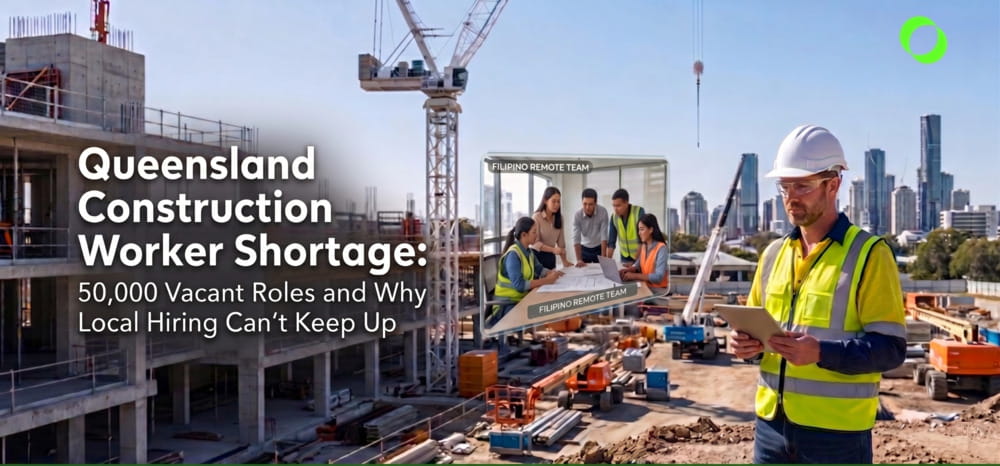
Queensland is 50,000 workers short as of early 2026.
When the third most populous state in Australia, home to a population of 5.5 million, is unable to fill the Queensland construction worker shortage, the problem becomes less a statistic and more a matter of urgency.
It’s not just construction workers either.
Key roles like Estimators, CAD Designers and Technicians, BIM Modellers, Accounts and Payroll Specialists, and Administrative Support are in the mix, too, among many others.
At the current pace of things, local talent pools won’t be able to meet the demand deluge, the Queensland Auditor-General’s Major Projects 2025 report confirms.
The work is waiting. But the workers are nowhere to be found.
So what does a Queensland construction business do when the local talent pool is wearing thinner by the day, and can’t keep up with the work that’s running on a tight, years-long deadline?
In This Blog:
-
-
- ➤Behind the Construction Worker Shortage Queensland Is Facing Today
- ➤QLD Construction Jobs Project Bottleneck: Are Estimators High In Demand In Australia?
- ➤Not Just A Construction Worker Shortage, Not Just An Estimator Shortage (+ QLD Construction Work Hours)
- ➤Why Is It So Hard to Find Construction Workers in Australia Right Now?
- ➤The Roles Are Being Filled, But Not The Way Most Think
- ➤FAQs
-
Why is there a construction worker shortage in Queensland?
Queensland is facing a massive construction worker shortage because four major pillars, housing, transport infrastructure, the net-zero energy transition, and Brisbane 2032 Olympics preparations, are all competing for the same limited local talent pool simultaneously. As project commissioning continues while supply remains stagnant, this deficit will compound annually, making traditional local hiring increasingly unsustainable.
Behind the Construction Worker Shortage Queensland Is Facing Today (Why 2026-27 is the Forecasted Peak)
The peak construction labor shortage Queensland is up against in 2026-27 comes from Construction Skills Queensland, or CSQ, an industry-funded body representing Queensland’s construction sector. They’re responsible for workforce planning and training investment, they make recommendations, and identify gaps throughout the sector and in construction occupations.
Their flagship workforce research report, Horizon 2032, is a decade-long outlook for Queensland’s construction workforce that ties to the Brisbane 2032 Olympics timeline.
That pipeline? It’s been said to grow from AU$53 billion in 2024-25 to AU$77 billion in 2026-27, and at the moment, beyond capacity.
According to the Construction Skills Queensland’s (CSQ) findings:
Queensland is heading for a peak shortage of 50,000 construction workers in 2026-27. The average shortfall is 18,200 workers per year, over the next eight years.
Four concurrent demand drivers pulling from the same workforce pool simultaneously:
- Housing construction targets
- Transport infrastructure (Cross River Rail, Gold Coast Light Rail, Sunshine Coast Rail)
- Net-zero energy transition
- Brisbane 2032 Olympic venues
Is the Main Cause of Queensland Skilled Worker Shortage the Brisbane 2032 Olympics?
No. Not entirely. The Brisbane Olympics construction demand is a driver, and one of the larger ones at that. But it’s not the major factor spinning the demand-supply propulsion out of order. The trade shortage Queensland issue had been plaguing the state and the continent at large since the post-pandemic construction boom of 2021 to 2022.
The sudden surge in residential building, infrastructure investment, and materials costs rubbed against an already reduced workforce, with skilled migration slipping from behind it and forcing a hiring block.
Facts about the construction worker shortage Queensland is dealing with at present:
- Queensland accounts for a disproportionate share, given its pipeline density, weighed against the national context
- Infrastructure Australia’s 2025 Market Capacity Report projects the national shortfall will reach 300,000 workers by mid-2027, up from 141,000 currently
- 11 of 17 Brisbane 2032 venues were still in business case processes (as of mid-2025)
- Queensland Government capital spend is AU$116.8 billion across four years in infrastructure, transport, housing, and public works
What To Do: The shortage isn’t constrained to construction work alone. If you’re in the construction industry, do an audit of your operations and manpower. Identify every role that’s either vacant or understaffed.
For any role that’s platform-based or doesn’t require physical site presence, offshore hiring is the immediate and viable answer right now.
QLD Construction Jobs Project Bottleneck: Are Estimators High In Demand In Australia?
Yes, estimators, among others, are in high demand. There are three shortage categories named by the QAO (Queensland Audit Office) report: Engineering, project management, and trade roles. Estimators are perched right in between the first two.
The lack of estimators in the industry can be particularly damaging because choke points mushroom before anyone sets foot on site. Estimators are responsible for reviewing plans and specs. They calculate qualities like materials, labour, and time, and price everything out from suppliers to equipment to wages. They build a cost estimate or bid.
It boils down to this: no estimators equals no tender. No pricing, no bid.
And this will compound, with the direction going nowhere else but upstream. Damage will only multiply from this one source of delay.
Important details about the estimator shortage:
- Queensland estimator listings as of April 2026 show open roles stacking up disproportionately against applicants
- Australia’s job boards consistently list civil engineering professionals, including quantity surveyors, among the most in-demand occupations nationally
- Surveyors Australia warns that the sector is about to hit a workforce shortfall of over 2,000 professionals per year by 2029
Headcount isn’t the predicament here. There’s an overwhelming scarcity of senior estimators with platform experience in tools like Buildsoft, Cubit, or CoConstruct. The local pool is there, but is largely composed of junior or mid-level workers.
Illustration: A Queensland subcontractor is missing a tender submission window because their company’s sole estimator resigned months ago. The replacement search is past the deadline, and they still can’t find a local candidate who can fulfil the role for the Queensland infrastructure workforce shortage.
Not Just A Construction Workforce Gap Australia’s Staring Down, Not Just An Estimator Shortage
The pre-site bottleneck isn’t the only leak in the building industry labor shortage QLD pipeline. Here are other roles that need filing, and why these, like Estimators, are best hired offshore.
Quantity Surveyors
Cost planning, contract administration, and financial reporting across the project lifecycle; in acute shortage.
Drafters and CAD Technicians
Produce construction drawings, shop drawings, and as-builts in AutoCAD, Revit, or ArchiCAD. Filipino drafters with AU construction project experience are among the most established offshore roles in the market.
BIM Modellers
Build information modelling for complex infrastructure and commercial projects. Where AU builders are increasingly adopting BIM-mandated procurement processes, demand for this role is rising.
Project Administrators and Document Controllers
RFI management, submittal tracking, contract documentation, and compliance registers. Their responsibilities do not need to be done on a site manager’s desk. The high-volume, process-driven work is system-based and is ideally offshored.
Scheduling Coordinators
Primavera P6 or MS Project-based programme management and progress reporting. This role is required in government-funded Queensland projects.
Accounts and Payroll Specialists for Construction
Progress claim processing, subcontractor payment schedules, and retention tracking. Construction-specific finance roles with AU compliance knowledge are easily available in global talent pools.
Related Read: Stay updated about the Modern Slavery Act Australia strictly adheres to, and how you can stay compliant in supply chains and more.
What’s the Biggest Killer in Construction? (Roles, Shortage, Remote Solutions)
Sources: Infrastructure Australia 2025 Market Capacity Report; CSQ Horizon 2032; Queensland Audit Office Major Projects 2025
What To Do: Go over this list and add roles you need apart from the ones mentioned. If more than two are vacant, or whoever’s fulfilling those roles is overloaded, now’s the time to launch your hiring roadmap.
QLD Construction Work Hours
On-site: Monday to Saturday, 6:30 am to 6:30 pm (noise regulation hours; shift hours will vary depending on contract and employer)
Off-site / Remote / Offshore :
7:00 am – 3:00 pm AEST
8:00 am – 4:00 pm AEST
9:00 am – 5:00 pm AEST
Normal office-style schedules aligned to Australian business operations.
Direct Channel
Have questions? Drop our team a line anytime.
Why Is It So Hard to Find Construction Workers in Australia Right Now?
Construction projects will continue to get commissioned year after year, and the work won’t stop. Every year the “construction jobs demand Queensland 2026″ goes unaddressed, it rolls over and adds to the next year’s deficit. The longer it goes unmet, the harder it becomes for the construction workforce in Australia to meet work demand.
As construction ramps up from 2027, it will compete with every other active project from then on.
Note:
Infrastructure Australia identifies that most shortage occupations require “a mix of general, technical, and specialised skills, which take time to develop.
Negative impacts as direct results of the worker scarcity:
- Some Queensland construction sites, averaging only 2.5 productive days per week, are bracing for productivity loss, which compounds the workforce shortage
- Labour scarcity is inflating project costs; construction cost growth in Brisbane is forecasted at 5% in 2026 (RLB), with regional Queensland at up to 6%
- 63% of firms cite labour cost as a substantial threat to project delivery
- 59% of firms cite labour and skills shortages (Infrastructure Australia industry survey)
Apart from these, there’s the competition issue. Smaller construction businesses and SMEs won’t be able to match the pay rates or guaranteed work volumes of larger, major contractors. Let alone government-backed projects bidding for the same scarce talent.
Local-only hiring is out of the equation, and the data proves so. Local training also takes years, while interstate recruitment has its constraints because every other Australian state is facing its own shortage.
Related Read: Don’t miss out on the current rules and changes about Payday Super 2026 and stay compliant as you grow your team during this skills shortage, and beyond.
The Roles Are Being Filled, But Not The Way Most Think
For every role that runs inside a platform and produces a measurable output, remote hiring is a direct and immediate answer to the shortage. Such roles don’t require a physical presence, and these include estimators, quantity surveyors, drafters, project administrators, accountants and bookkeepers, administrative roles, BIM modellers, and schedulers.
All are platform-based by nature.
Filipino remote professionals working in this industry typically hold degrees in civil or structural engineering, quantity surveying, construction management, or architecture. Most bring several years of hands-on experience, such as direct work on AU residential, commercial, and civil projects.
Remote Staff Australia has been placing remote professionals with Australian construction businesses for 18 years. On cost: the local hire equivalent for most of these roles carries a base salary of AU$80,000 to AU$120,000 before Superannuation, leave entitlements, and more.
A comparable remote professional represents a materially lower total spend, not because the capability is different, but because the cost of living in their market is.
Related Read: Wondering what Australian business owners are asking about What Is a Marketing Automation Specialist and The Best No Code App Development Platforms for Australian Businesses? Quick reads so you don’t miss out.
FAQs
Can a remote estimator handle AU construction software like Buildsoft or Cubit?
Yes. Filipino construction professionals working in the offshore market frequently have hands-on experience with AU-standard estimating platforms, including Buildsoft, Cubit, Bluebeam, and CoConstruct. Screen for demonstrated project output, not just platform name recognition on a resume.
Is the estimator shortage in Queensland expected to ease anytime soon?
Not within the current infrastructure cycle. CSQ projects the average shortfall persisting across the next eight years, with the peak hitting in 2026-27. The Brisbane 2032 construction ramp-up from 2027 adds further pressure to the shortage of builders Queensland is facing.
What’s the difference between a remote estimator and a quantity surveyor?
A remote estimator focuses primarily on pricing, takeoffs, and bid preparation. A quantity surveyor covers a broader scope, including cost planning, contract administration, and financial reporting across a project’s lifecycle. Both roles are in acute shortage in Queensland.
How quickly can a remote estimator be operational?
With clean software access and a documented tender process, most remote estimators contribute within two to three weeks. Businesses that hand over a brief, platform login, and one completed example tender consistently report better ramp-up times.
Demand Won’t Ease Up, Neither Will Local Supply Catch Up Quickly
The point is that hiring remotely is the remedy. There’s no other way around it, unless you’re willing to gamble on a local search that drags on for months to years.
You settle for a candidate who doesn’t have the expertise you’re looking for, and all the while, projects are halted. Everything, from tenders delayed to understaffed bid teams, brings costs in from different sides, layer upon layer.
The numbers may look like they’re just part of another statistic. But if you’re a serious business owner, you know that they represent a moment that can change how you build and grow your team, and how far ahead of the market you end up.
The remote estimator model is already working for AU construction businesses. The talent is vetted and available.
The decision is whether to move now or after the next worker shortage. Request a Callback to discuss your estimating requirements today.

Vaune Everis Cura has always been a writer in the truest sense, drawn to the art both as a personal creative pursuit and as a profession. Her experience penning content across digital marketing spaces and collaborating with business owners and market shapers has broadened her craft to include strategic direction and SEO insight. Having spent years with the InterContinental Hotels Group before stepping boldly into freelancing, she understands that at the centre of it all are genuine, meaningful brand–customer relationships built on purposeful, human content.